About Haemanthus crispus Snijman
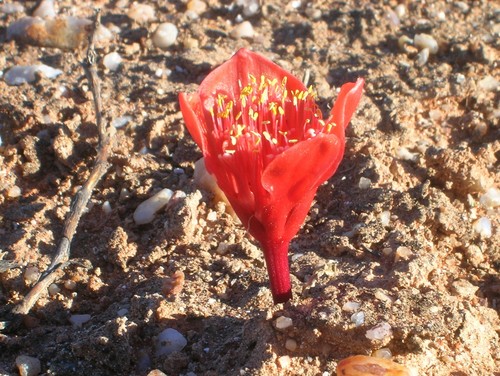
The specific epithet crispus is Latin for "curled" or "crinkled". Haemanthus crispus Snijman is a bulbous geophyte native to South Africa, belonging to the genus Haemanthus. It occurs in the winter rainfall region of Namaqualand, where it is a common species. Its distribution ranges from Steinkopf to the Olifants River; it grows from coastal flats eastward onto the stony lower slopes of the first terrace, typically in heavy soils and often in the shade of low succulent shrubs. This species may grow as solitary plants, or like many other Haemanthus species, form large gregarious clumps. It produces 1 to 3 leaves that emerge shortly after flowering. Leaf blades can be hairy or glabrous, are canaliculate, and bear maroon spots and bars on their abaxial surface. Leaf margins are strongly crisped or crinkled, a feature that may extend along the full leaf length or only be present near the base, and the margins are occasionally edged in red. Flowers and spathe valves appear from March to May; they are usually red, though occasionally pink. When ripe, fruits are pink, pulpy, and up to 20 mm in diameter, each containing 1 to 4 dark-red seeds. Unlike most other winter rainfall Haemanthus species, the bulb tunics of H. crispus have edges that form horizontal girdles, rather than the typical distichous arrangement.