About Habroscelimorpha dorsalis (Say, 1817)
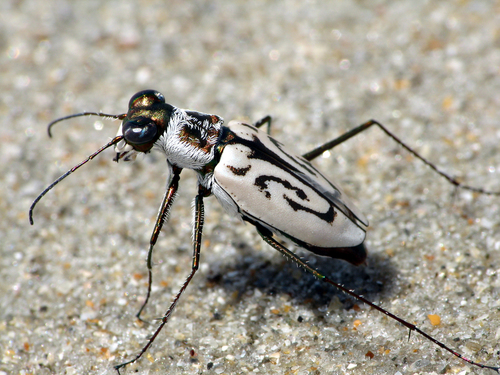
Adults of Habroscelimorpha dorsalis have a body length ranging from 13 to 15 millimetres (0.51 to 0.59 in). Their head and thorax are bronze-green, their legs are long and slender, and their elytra range from white to light tan with narrow bronze markings. The head bears long antennae, large compound eyes, and powerful jaws. White hairs grow on the pronotum and along the sides of the abdomen. The species' pale coloration acts as camouflage when it is on light sand. Larvae of this species are grub-like, with long segmented bodies and large jaws that resemble the jaws of adult beetles. Habroscelimorpha dorsalis dorsalis, commonly called the Northeastern beach tiger beetle, is the largest subspecies of H. dorsalis. In 2012, the former subgenus Habroscelimorpa was reclassified to full genus status. As its common name suggests, the Northeastern beach tiger beetle lives along the northeastern coast of the United States, where it dwells in small sand burrows. This subspecies is highly vulnerable to high levels of human activity and beach erosion, and in 1990, it was listed as threatened under the U.S. Endangered Species Act (ESA). It is the only subspecies of H. dorsalis that is listed under the ESA. Larvae of the subspecies H. d. media have a notable unusual ability: they can leap into the air, curl their body into a rotating wheel, and roll quickly across sand propelled by wind. If wind conditions are strong enough, a larva can travel up to 60 metres (200 ft) using this rolling movement. This unusual ability may have evolved to help larvae escape predators such as the thynnid wasp Methocha. Wheel-based locomotion is extremely rare in nature, and has only been observed in a small number of animal species worldwide. In terms of range and habitat, H. d. media is found along the southeast coast of the United States, including South Carolina. H. d. dorsalis occurs along the northeast coast of the United States. H. d. saulcyi and H. d. venusta are found along the coasts of Florida, the Gulf of Mexico, and Mexico. Overall, Habroscelimorpha dorsalis is most abundant on wide, fine-sand beaches that are highly exposed to tidal action and relatively undisturbed by human activity. For successful breeding, beaches must be at least 100 metres (330 ft) long and 2 metres (6 ft 7 in) wide, with an optimal breeding width of 5 to 8 metres. Habroscelimorpha dorsalis prefers climates with average temperatures over 15 °C and moderate to arid annual rainfall.