About Habropoda laboriosa (Fabricius, 1804)
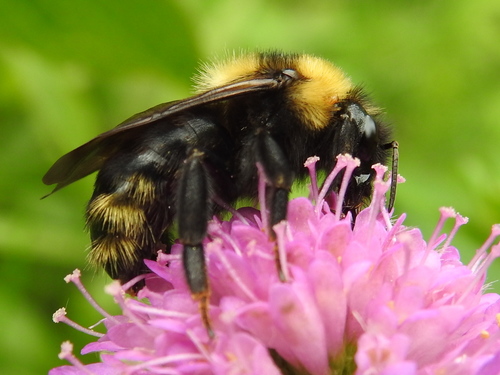
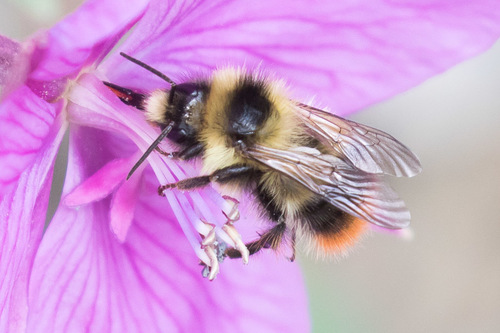
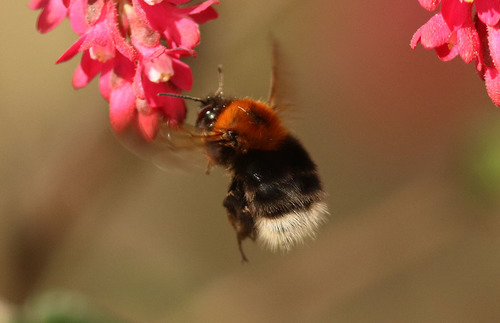
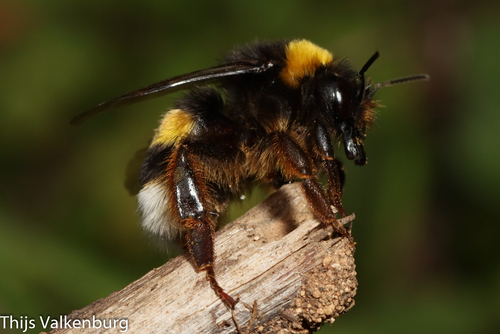
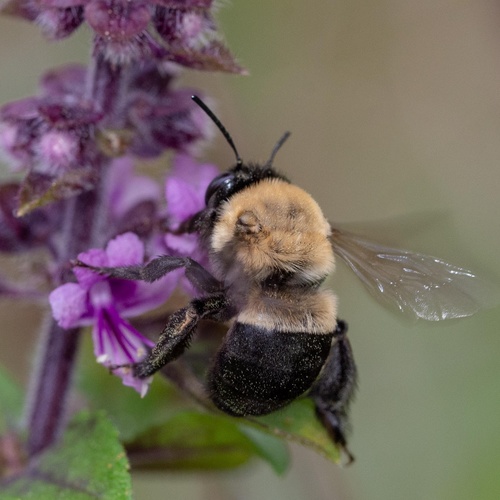
Habropoda laboriosa, commonly known as the blueberry bee, is a species of solitary bee. Solitary by nature, these bees prefer to live alone, though their individual nests are often located close to one another. They dig their own underground tunnels that are slightly wider than their bodies, and may dig these tunnels in areas shared by other members of their own species. They typically choose nesting spots that get direct sunlight and have a low risk of flooding. As solitary bees, mother bees only gather and provide food and nutrients for their own brood. Blueberry bees are active for just 3 to 5 weeks each year, and produce only one generation of offspring annually. They closely resemble bumble bees, but are smaller in overall size. There is a clear size difference between female and male H. laboriosa: females measure 15.5 mm to 16 mm in length, while males measure 13 mm to 14 mm in length. Females have an entirely black head, while males are mostly black with a yellow clypeus. This species is native to the eastern United States, where it lives in warm, humid conditions. They nest underground at depths ranging from 33 cm to 71 cm, in moderately dry, sandy soil. Their range extends across the eastern U.S. from Illinois to the New England states, and south as far as Mississippi and Florida. As solitary ground-nesting bees, they prefer low-moisture soil covered by leaf litter, with few roots near the nest to help keep the soil relatively dry. Burrows are hidden under this leaf litter, and connect to tunnels that can be up to 20 cm long leading to the main nest. If their nest is invaded or disturbed by other organisms, bees will usually abandon the nest to find a new area to nest. A common example of this disturbance is invasion by the ant species Iridomyrmex humilis, which often leads to nest abandonment. Nests are also abandoned when cleptoparasitic cuckoo bees of the genus Melecta parasitize the nest by laying their own eggs there. These parasitic offspring then use the pollen and food resources the host bee collected for its own offspring to develop. When searching for new potential nesting sites, H. laboriosa prefers areas that have already been dug but are not inhabited by other organisms. These nesting sites are often located near blueberry orchards, in pits that have been previously plowed. H. laboriosa performs a specialized pollination method called buzz pollination, and is an oligolectic (specialist) pollinator of Vaccinium ashei and Gelsemium sempervirens. To perform buzz pollination, the bee latches onto a plant’s anthers and vibrates its thoracic muscles and wings at a frequency between 100 and 500 Hz. This vibration causes pollen to eject from the anthers, and the pollen then lands on the bee’s body. When the bee visits a different blueberry plant, pollen carried on its body transfers to the plant’s female reproductive organ to achieve fertilization. This behavior is specially adapted to extract pollen from blueberry plants. Blueberry plants require this specific vibration to efficiently release their pollen, as their pollen is naturally heavy and adherent, making it hard for other pollinators to collect. This adaptation makes H. laboriosa a particularly efficient pollinator for blueberry plants. While buzz pollination was first discovered over 100 years ago, much about this behavior remains understudied, due to the difficulty of measuring these vibrations during natural pollination events. H. laboriosa emerges between late February and April, and is only active during this period to pollinate blueberry plants, which only flower and bloom at this time. They can emerge before the start of spring because they can tolerate cooler weather. They warm themselves by vibrating their thoracic muscles, which allows them to fly in temperatures as low as 60 degrees Fahrenheit. The vibration of their thoracic muscles produces a sound observers describe as buzzing; during pollination, this buzzing is higher pitched than the buzzing produced during normal flight, because the bees vibrate at a higher frequency when pollinating. They are no longer active by the time blueberry fruit is ready for harvest, so they are only present and active for a few weeks each year. Compared to bumble bees, female H. laboriosa find pollen and nectar more quickly, and spend most of the day collecting pollen and nectar when temperatures are in their preferred range. Male and female blueberry bees behave differently when foraging for pollen and nectar. Females carry more pollen grains on 4 out of 5 parts of their bodies, while males typically carry a wider variety of pollen types, which increases the chance of successful plant fertilization.