About Gyrodon lividus (Bull.) Sacc.
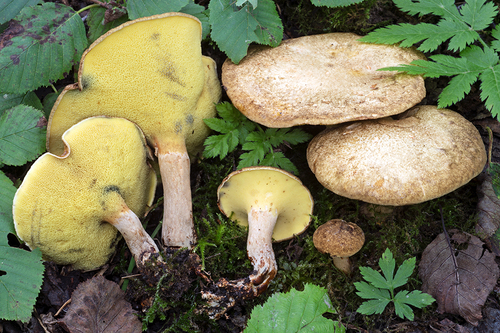
Gyrodon lividus has a pale brown, buff, or ochre cap 4–10 cm (1.5–4 in) in diameter. The cap starts convex and becomes flat with age, and it can become sticky when wet. Like other boletes, its hymenophore (the spore-bearing tissue on the underside of the cap) is made of pores instead of gills. These large, bright yellow pores attach decurrently down the stipe, and turn blue-grey when cut or bruised. The thin flesh of the mushroom is pale yellow. The stipe has no ring, matches the cap's colour when young, and darkens to red-brown as it matures; it reaches 3–7 cm (1–3 in) in height and 1–2 cm (0.5–1 in) in width. The spore print is olive-brown, and the oval spores measure 4.5–6 x 3–4 μm. This mushroom has no distinctive smell or taste. In the United States, Gyrodon lividus can be confused with two similar species. The first is Boletinellus merulioides, which is generally larger overall with larger spores, and grows under ash trees (Fraxinus). The second is B. proximus, which has a dark brown or purple-brown cap, does not change colour when bruised, and is only found in Florida. Gyrodon lividus is distributed across Europe, including Ķemeri National Park in Latvia. In Asia, it has been recorded in China and Japan, and is found in multiple areas of Turkey including Trabzon, Maçka, and Sevinç. In North America, it has been reported growing in California under white alder (Alnus rhombifolia). As its common name implies, this species grows with alder (Alnus rhombifolia), forming a mycorrhizal relationship with the tree. Fruit bodies can grow alone or in clumps, and appear in autumn. Young ectomycorrhiza of this fungus are characteristically yellow, have highly differentiated rhizomorphs, and contain sclerotia.