About Gyps rueppellii (A.E.Brehm, 1852)
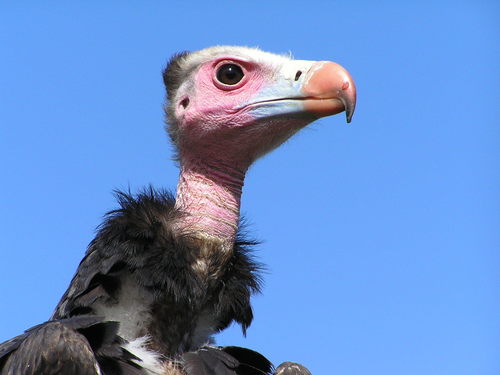
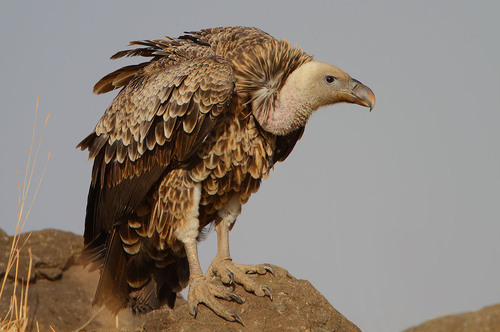
Rüppell's vulture (Gyps rueppellii, formally described by A.E.Brehm in 1852) is a very large vulture species that is noticeably larger than its close relative the white-backed vulture, and the two species often occur together in the wild. Adult Rüppell's vultures measure 85 to 103 cm (33 to 41 in) in body length, have a wingspan of 2.26 to 2.6 m (7 ft 5 in to 8 ft 6 in), and weigh between 6.4 and 9 kg (14 to 20 lb). Males and females look identical. Their overall plumage is mottled brown or black, with a whitish-brown underbelly, and thin, dirty-white downy fluff covering the head and neck. The base of the neck has a white collar, the eyes are yellow or amber, and the crop patch is deep brown. The head has no feathers, an adaptation to the species' habit of sticking its head inside prey carcasses while feeding; this adaptation prevents extreme mess during feeding that would occur if feathers were present. Rüppell's vultures are typically silent, but become vocal at their nests and when feeding at a carcass, where they squeal frequently. These vultures commonly fly at altitudes up to 6,000 m (20,000 ft). They have a specialized variant of the hemoglobin alphaD subunit; this protein has a high affinity for oxygen, which allows the species to absorb oxygen efficiently despite the low oxygen partial pressure in the upper troposphere. One confirmed collision record exists: on 29 November 1973, a Rüppell's vulture was ingested into the engine of an aircraft flying at 11,300 m (37,000 ft) over Abidjan, Ivory Coast. Regarding distribution and habitat: since 1992, Rüppell's vulture has occurred as a vagrant in Spain and Portugal, with annual records recorded since 1997. Most vagrant records are from the Cádiz and Strait of Gibraltar area, though vagrants have also been recorded further north. In Morocco, Rüppell's vulture is a resident species, and some tagged individuals have been observed overwintering there. For reproduction: this vulture species is monogamous, forming lifelong breeding pairs. After courtship, the pair works together to build a nest from sticks, grass, and leaves, which they may either gather themselves or steal from other nests. Rüppell's vultures build their nests on cliffs, and in major breeding areas they nest in large colonies that can hold hundreds of breeding pairs. Both parents share incubation of their single egg over a 55-day period. After the chick hatches, both parents feed and care for it for around 150 days, until the chick fledges. Young vultures remain dependent on their parents after fledging, and do not become independent until the next breeding season; during this dependency period, they learn how to find and compete for food. Because of the species' large feeding range, pairs can only rear a single chick at a time. This limitation comes from the energy requirements for flight and foraging, in addition to the energy needed to feed the chick.