About Gyps himalayensis Hume, 1869
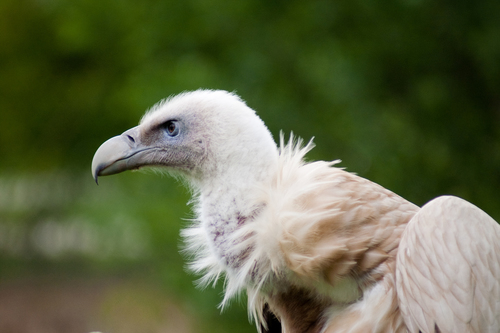
The Himalayan vulture, or Gyps himalayensis Hume, 1869, has dark brown greater covert feathers, tail, and wing quills. Its upperside is uniformly pale buff, and its inner secondaries have paler tips. Its legs are covered in buffy feathers, and range in color from greenish grey to pale brown. The underside and under-wing coverts are pale brown or buff, and are almost white in some individuals. Immature individuals have whitish down on their head; this down becomes yellowish in adults. Adults have a long pale brown ruff with white streaks, and the ruff feathers are long and spiky. This species has pale blue facial skin, which is lighter than the dark blue facial skin of Gyps fulvus, and has a yellowish bill. When in flight, its long fingers are splayed, and it has a pale patagial stripe on the underwing. Its dark wing and tail feathers contrast with its pale coverts and body, and this contrast is one of the best ways to distinguish this species from the slightly smaller griffon vulture. The body feathers have pale shaft streaks. It is the largest species in the Gyps genus, averaging larger in all measurement types than its relatives, and is possibly the largest and heaviest bird found in the Himalayas. The weight of Himalayan vultures ranges from 6 kg (13 lb) to 12.5 kg (28 lb). The average weight is estimated at 9 kg (20 lb), but weights vary by condition between 8–12 kg (18–26 lb). Published measurements of wingspan range from 2.56 to 3.1 m (8 ft 5 in to 10 ft 2 in), which is a similar range to that of the cinereous vulture. Wingspan measurements vary greatly depending on the method used to collect them. This species differs from the similarly colored Indian vulture (G. indicus) by its stouter, more robust bill. Younger Himalayan vultures have a pale bill, and typically have buffy-white streaks on the scapulars and wing coverts that contrast with their dark brown underparts. It is similar in size to the cinereous vulture (Aegypius monachus); the cinereous vulture usually has a slightly shorter overall length, but can weigh more than the Himalayan vulture. The Himalayan vulture primarily inhabits the higher regions of the Himalayas and the Tibetan Plateau, at elevations between 1,200–5,500 m (3,900–18,000 ft). Its distribution extends from Kazakhstan, Uzbekistan, Kyrgyzstan, Tajikistan, Afghanistan, and Iran east through Pakistan, India, Nepal, and Bhutan to western China and Mongolia. Juvenile birds may disperse further to the south, and vagrant individuals have been recorded in Thailand, Burma, Singapore, and Cambodia.