About Gyps fulvus (Hablizl, 1783)
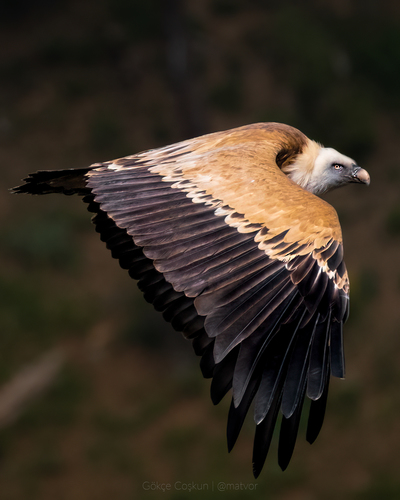
This species has the scientific name Gyps fulvus (Hablizl, 1783), and is commonly called the griffon vulture or Eurasian griffon vulture. Adult griffon vultures measure 93–122 cm (37–48 in) in length, with a wingspan of 2.3–2.8 m (7 ft 7 in – 9 ft 2 in). For the nominate race, males weigh between 6.2 and 10.5 kg (14 to 23 lb), while females typically weigh between 6.5 and 10.5 kg (14 to 23 lb). Individuals of the Indian subspecies G. f. fulvescens have an average weight of 7.1 kg (16 lb). Recorded extreme weights for adult griffon vultures range from 4.5 to 15 kg (9.9 to 33.1 lb); the maximum of this range is most likely a weight of an individual held in captivity. Hatchlings are naked when they emerge, and the species matches the typical appearance of an Old World vulture: it has a white head, very broad wings, and short tail feathers. It also has a white neck ruff, a yellow bill, and buff body and wing coverts that contrast with its darker flight feathers. The Eurasian griffon vulture is a permanently resident species across parts of its range, including the Iberian Peninsula, eastern Atlas Mountains, eastern Alps, parts of Anatolia, the Caucasus, parts of the Arabian Peninsula, the Iranian plateau, Tian Shan, and Altai Mountains. In Portugal, a few hundred breeding pairs of griffon vultures nest, but their distribution across the country is strongly asymmetric. More than half of the entire Portuguese national population lives and breeds in Douro International Natural Park, the main reproduction area for the species here. Though griffon vultures stay permanently in the interior of Portugal, they often travel west after the breeding season ends, and can occasionally reach Tagus Estuary Natural Reserve and Cape St. Vincent. The first recorded observation of a griffon vulture in Ireland dates to 1843, when one was recorded in Cork. In 2000, one individual vulture settled and resided on Guernsey island. A colony of Eurasian griffon vultures lives near the town of Beli on Croatia’s Cres island. On Cres, these vultures breed at low elevations, with some nests located just 10 m (33 ft) above sea level. This low elevation breeding leads to common contact between the vultures and people. Vultures from this Croatian colony often make incursions into Slovenian territory, especially around Mount Stol above Kobarid. The species is protected in the Kuntrep area on Croatia’s Krk island. In Serbia, there are approximately 450 to 500 total Eurasian griffon vultures: around 110 breeding pairs live around Zlatar mountain, and an additional 35 individuals live in the Trešnjica river canyon. In Greece, the total Eurasian griffon vulture population is close to 1000 individuals. Most of this Greek population lives on Crete, which hosts the largest insular population of this species anywhere in the world. On Crete, griffon vultures live in mountainous areas, and sometimes gather in groups of up to 20 individuals. In 2006, a colony of fewer than 30 Eurasian griffon vultures existed at Episkopi, in southern Cyprus. The species went locally extinct in Germany in the mid-18th century. Around 200 vagrant griffon vultures, likely originating from the Pyrenees, were sighted in Germany in 2006. Several dozen of the vagrants sighted in Belgium the following year crossed into German territory. The most recent population estimate for Armenia counts 46 to 54 breeding pairs, and the population trend here shows a slight increase. Griffon vultures breed on rocky crags in mountains of southern Europe, North Africa, and Asia, and lay only one egg per clutch. They may form loose breeding colonies, and most of the global population is non-migratory and resident. For this colonial species, density dependence has been shown to impact annual reproductive success. Breeding birds preferentially use eyries in protected locations, such as caves, potholes, and sheltered ledges, which produce more fledged young than lower-quality eyries on exposed ledges or in open crevices. Low-quality eyries are only used when the number of breeding individuals in the colony increases. The maximum recorded lifespan for a griffon vulture is 41.4 years, recorded for an individual held in captivity.