About Gyps bengalensis (Gmelin, 1788)
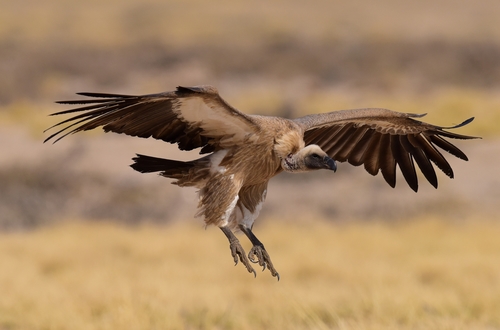
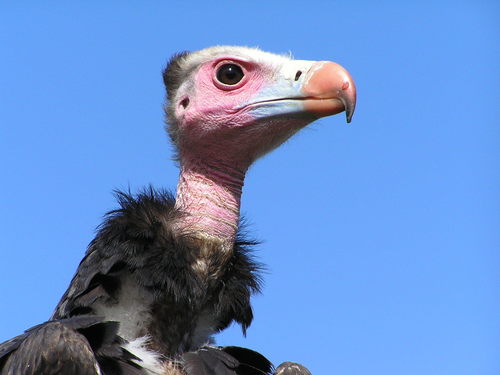
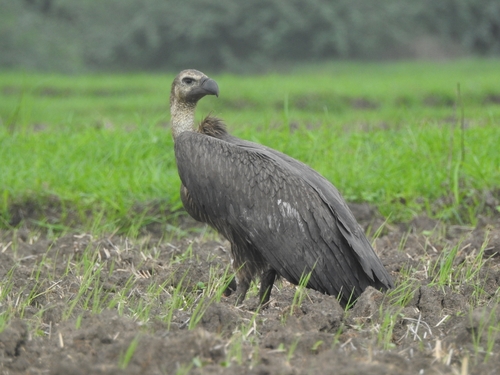
The white-rumped vulture (Gyps bengalensis) is a medium-sized, typical vulture, with an unfeathered head and neck, very broad wings, and short tail feathers. It is much smaller than the Eurasian Griffon, and is the smallest of all Gyps vultures, while still being a very large bird overall. It has a white neck ruff. For adult individuals, the whitish back, rump, and underwing coverts contrast with the vulture's otherwise dark plumage. The body is black, and the secondary flight feathers are silvery grey. The head has a pink tinge, and the bill is silvery with dark ceres. The nostril openings are shaped like slits. Juvenile vultures are mostly dark all over, and take roughly four to five years to grow in their full adult plumage. In flight, adult white-rumped vultures have a dark leading edge to the wing, and a white wing-lining on the underside. The undertail coverts are black. This species has a weight of 3.5–7.5 kg (7.7–16.5 lb), a body length of 75–93 cm (30–37 in), and a wingspan of 1.92–2.6 m (6.3–8.5 ft).
This vulture builds its nests on tall trees, often located near human habitations, across northern and central India, Pakistan, Nepal, Bangladesh, and southeast Asia. It lays only one egg per nesting attempt, forms roosting colonies, and most of the population stays in its range year-round, with no long-distance migration. Like other vultures, the white-rumped vulture is a scavenger that feeds mostly on animal carcasses. It finds carcasses by soaring high in thermals and spotting other scavengers. A 19th century experimenter who hid a dog carcass in a sack in a tree concluded the species is capable of locating carrion by sense of smell. It often flies and perches in flocks. At one point in time, it was the most abundant vulture species in India. Within the well-supported clade of the genus Gyps, which includes populations from Asia, Africa, and Europe, studies have found that this species is basal, with all other Gyps species having diverged more recently.
White-rumped vultures typically become active after the morning sun has warmed the air enough to form sufficient thermals to support their soaring flight. They were once seen in large numbers above the city of Calcutta. When the vultures locate a carcass, they quickly descend and feed voraciously. They perch on nearby trees, and have been recorded sometimes descending to feed even after dark. At feeding sites, the white-rumped vulture is dominated by the red-headed vulture (Sarcogyps calvus). In forested areas, the soaring flight of this species often indicated the location of a tiger kill. The vultures will swallow pieces of old, dry bones, including ribs and pieces of skull from small mammals. Where water is available, they bathe regularly and also drink water. One observation recorded that a pack of white-rumped vultures cleaned up an entire bullock carcass in roughly 20 minutes. Trees that the vultures use regularly for roosting are often stained white from their excreta, and the acidity of the excreta often kills the trees. This made the species less welcome in orchards and plantations. They will sometimes feed on dead white-rumped vultures. One individual was recorded getting caught in the mouth of a dying calf. Jungle crows have been observed stealing food that adult vultures regurgitate for their young.
Allan Octavian Hume recorded hundreds of nests, and noted that white-rumped vultures historically nested on large trees near human habitations even when suitable cliffs were available nearby. The nesting trees preferred by the vultures are Banyan, Peepul, Arjun, and Neem. The main nesting season runs from November to March, with most eggs laid in January. Several breeding pairs will nest near each other, and isolated nests usually belong to younger birds. Nests are lined with green leaves. In Mudumalai Tiger Reserve, white-rumped vultures primarily used Terminalia arjuna and Spondias mangifera trees for nesting, at an average height of 26.73 m (87.7 ft). The nests there measured 1 m (3 ft 3 in) long, 40 cm (16 in) wide, and 15 cm (5.9 in) deep. Hatchlings were recorded between the first and second week of January. Solitary nests are not used regularly, and are sometimes taken over by red-headed vultures and large owls such as the great horned owl Bubo coromandus. The male initially collects twigs and arranges them to build the nest. During courtship, the male rubs his bill against the female's head, back, and neck. The female invites copulation, and the male mounts her while holding her head in his bill. Usually, the female lays a single egg, which is white with a faint bluish-green tinge. If an egg is lost, the female will destroy the nest. The vultures are usually silent, but produce hissing and roaring sounds at the nest or when jostling for position at feeding sites. Eggs hatch after around 30 to 35 days of incubation. Newly hatched chicks are covered in grey down. Both parents feed the chicks with bits of meat taken from carcasses. Young vultures stay in the nest for around three months before fledging.
Mycoplasmas have been isolated from tissue samples of a white-rumped vulture. Mallophagan parasites including Falcolipeurus and Colpocephalum turbinatum have been collected from this species. Ticks of the species Argas (Persicargas) abdussalami have been collected in large numbers from the roost trees of these vultures in Pakistan. A captive individual of this species lived for at least 12 years.