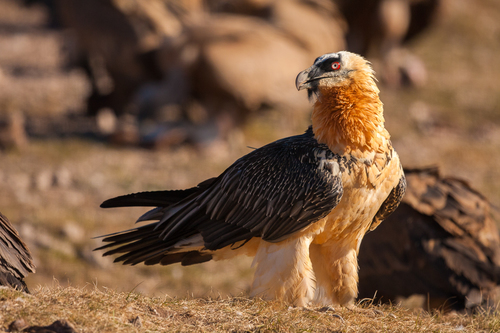
About Gypaetus barbatus (Linnaeus, 1758)
Description: The bearded vulture (Gypaetus barbatus) measures 94–125 cm (37–49 in) in body length, with a wingspan of 2.31–2.83 m (7 ft 7 in – 9 ft 3 in). It weighs 4.5–7.8 kg (9.9–17.2 lb): the nominate race averages 6.21 kg (13.7 lb), while the African subspecies G. b. meridionalis averages 5.7 kg (13 lb). In Eurasia, bearded vultures living around the Himalayas tend to be slightly larger than those from other mountain ranges, and females are slightly larger than males. It can be easily distinguished from other vultures or other birds when in flight by its long, narrow wings, which have a 71.5–91 cm (28.1–35.8 in) wing chord, and long, wedge-shaped tail that measures 42.7–52 cm (16.8–20.5 in) in length. The tail is longer than the width of the wing. Relative to the bird’s overall size, the tarsus is relatively small at 8.8–10 cm (3.5–3.9 in). The species’ overall proportions have been compared to a falcon, scaled up to an enormous size. Unlike most vultures, the bearded vulture does not have a bald head. It has a relatively small head, paired with a powerful, thick neck. Its body shape is generally elongated and slender, though it may sometimes appear bulkier because these birds often hold a hunched back. When moving on the ground, its gait is waddling, and it has large, powerful feet. Adult bearded vultures are mostly a mix of dark grey, rusty, and whitish. Their upperparts are grey-blue to grey-black. A creamy-coloured forehead contrasts against a black band that stretches across the eyes and lores, plus bristles under the chin that form a black beard — the feature that gives the species its English name. Bearded vultures often have variable orange or rusty plumage colour on their head, breast, and leg feathers, but this colouration is thought to be cosmetic; it comes from dust-bathing or rubbing iron-rich mud onto their bodies, and the birds also transfer this brown colour to their eggs. The tail feathers and wings are dark grey. Juvenile bearded vultures are dark black-brown across most of their body, with a grey-brown breast. They gradually develop more adult-like plumage over successive years, taking five to seven years to reach full maturity, and do not begin breeding until they are eight years old or older. The bearded vulture is normally silent, and only produces vocalizations: shrill whistles during breeding displays, and a falcon-like cheek-acheek call around the nest. Distribution and habitat: The bearded vulture has a vast but sparsely distributed range. It inhabits mountainous regions across the Pyrenees, the Alps, the Arabian Peninsula, the Caucasus region, the Zagros and Alborz Mountains of Iran, the Koh-i-Baba in Bamyan, Afghanistan, the Altai Mountains, the Himalayas, Ladakh in northern India, and western and central China. In Africa, it lives in the Atlas Mountains, the Ethiopian Highlands, and an area extending south from Sudan to northeastern Democratic Republic of the Congo, central Kenya, and northern Tanzania. An isolated population lives in the Drakensberg in South Africa. It has been reintroduced to multiple sites in Spain, including the Sierras de Cazorla, Segura and Las Villas Jaén, the Province of Castellón, and Asturias. As of 2018, the total global resident population was estimated at 1,200 to 1,500 individuals. In Israel, the species has been locally extinct as a breeding population since 1981, though young birds were recorded in 2000, 2004, and 2016. The species is entirely extinct in Romania; the last Carpathian specimens were shot in 1927, though unconfirmed sightings were reported in the 2000s, and in 2016 a specimen from a French restoration project flew over Romania before returning to the Alps. As of 2010, the southern African population was estimated at around 632 total birds: 408 adult birds and 224 young birds of all age classes. In Ethiopia, the species is common at garbage dumps on the outskirts of small villages and towns. While it occasionally descends to 300–600 m (980–1,970 ft), the bearded vulture is rare below 1,000 m (3,300 ft) and normally resides above 2,000 m (6,600 ft) in parts of its range. It typically lives around or above the tree line near mountain summits, reaching up to 2,000 m (6,600 ft) in Europe, 4,500 m (14,800 ft) in Africa, and 5,000 m (16,000 ft) in central Asia. In southern Armenia, it breeds below 1,000 m (3,300 ft) if sufficient cliff nesting sites are available. It has even been observed living at 7,500 m (24,600 ft) in the Himalayas, and recorded flying at 7,300 m (24,000 ft). Two bearded vultures from Alpine reintroduction schemes have reached the United Kingdom. The first sighting occurred in 2016 in Wales and the Westcountry. A series of 2020 sightings documented an individual nicknamed 'Vigo' by Tim Birch of the Derbyshire Wildlife Trust (originating from the reintroduced Alpine population), spotted separately over the Channel Island of Alderney after migrating north through France, then in the Peak District, Derbyshire, Cambridgeshire, and Lincolnshire. Because both of these individuals were captive-released rather than wild, they are classified as Category E (escapes) and have not been added to the formal British bird list. Reproduction and life cycle: The bearded vulture holds a large year-round territory, and may forage across 2 km² (0.77 sq mi) each day. Its breeding season varies by region: it runs December through September in Eurasia, November to June in the Indian subcontinent, October to May in Ethiopia, year-round in eastern Africa, and May to January in southern Africa. Although the species is generally solitary, breeding pairs often form very close bonds. Bearded vultures practice biparental monogamous care, though polyandry has been recorded in a small number of cases. Territorial and breeding displays between bearded vultures are often spectacular, and include showing talons, tumbling, and spiraling during solo flight. Pairs also regularly lock feet with each other and fall some distance through the sky together. In Europe, there are an estimated 120 breeding pairs. Mean productivity is 0.43±0.28 fledglings per breeding pair per year, and average breeding success is 0.56±0.30 fledglings per pair per clutch/year. The bearded vulture builds its nest as a massive pile of sticks: new nests measure around 1 m (3 ft 3 in) across and 69 cm (27 in) deep, while repeatedly used nests can grow to 2.5 m (8 ft 2 in) across and 1 m (3 ft 3 in) deep. Reused nests are lined with various animal matter leftover from food. The female usually lays a clutch of 1 to 2 eggs, though clutches of 3 have been rarely recorded. Eggs are incubated for 53 to 60 days. After hatching, young stay in the nest for 100 to 130 days before fledging. Fledged young may remain dependent on their parents for up to 2 years, which regularly forces breeding pairs to nest only in alternate years. Bearded vultures almost always nest in caves, on ledges, or on rock outcrops on steep rock walls, which makes the nests very difficult for nest-predating mammals to access. Wild bearded vultures have a mean lifespan of 21.4 years, and captive individuals have lived for at least 45 years. Bearded vulture nests can be used for centuries by multiple generations of birds, confirmed by the discovery of carbon-14 dated objects (including shoes) from different periods spanning the 13th to 19th centuries in a single nest. This nest was located in southern Spain, in an area where the species became extinct around the start of the 20th century.