About Gynandropsis gynandra (L.) Briq.
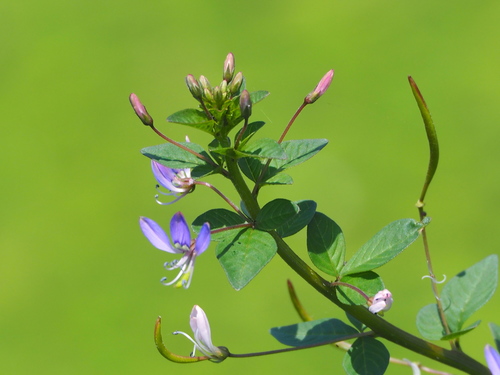
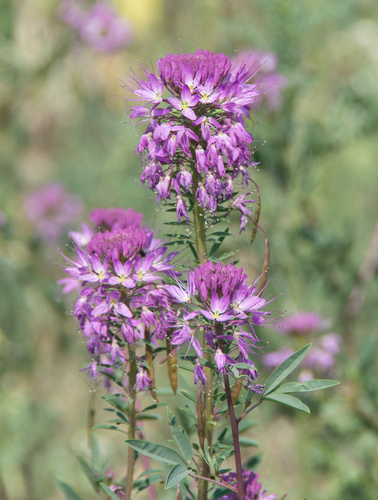
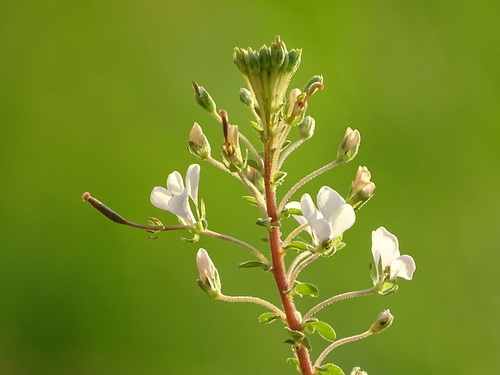
Gynandropsis gynandra (L.) Briq. is also referred to as Cleome gynandra. This is an erect, branching plant that generally grows between 25 cm and 60 cm tall. Under favorable environmental conditions, it can reach a maximum height of 150 cm. Its sparse leaves are each composed of 3 to 7 oval-shaped leaflets. The plant produces white flowers that sometimes turn rose pink as they age. Both its leaves and flowers are edible. The leaves have a strong bitter flavor, sometimes with a peppery note, similar to mustard greens. Its fruit is a dehiscent silique, which is a slender, spindle-shaped capsule that grows up to 12 cm long and 8–10 mm wide. As the pods ripen, their color changes from green to yellow, turning brown when fully dry. In their dry state, the pods split open longitudinally to release their seeds. Each silique can hold between 100 and 150 seeds. The seeds are round, black, have a rough surface, and measure 1.0–1.5 mm in diameter, and contain 17–19% oil. The plant has a long taproot with root hairs, and produces few secondary roots. This species is an annual wildflower native to Africa, and has become naturalized across tropical and subtropical regions of Africa, Asia, and the Americas. Within these regions, it grows at altitudes ranging from 0 to 2400 m above sea level. It grows well in disturbed, well-drained soils, and is drought-tolerant. It does not tolerate cold temperatures well, is frost-tender, and has optimal growth at temperatures between 18 °C and 25 °C with high light intensity. It is classified as an invasive weed in many areas of the U.S. and other locations across the Pacific. For use as food, its leaves and young shoots are most often eaten boiled or added to stews. Leaves are commonly consumed in Sub-Saharan Africa, where they are frequently dried for storage, then cooked with milk or butter to reduce their bitter taste. In Kenya, Uganda, and Tanzania, the leaves are cooked with groundnut paste. In Northern Uganda, the plant is known locally as Dek Akeo or Akeyo. It is prepared by boiling in hot water mixed with groundnut paste, and served with kalo, posho, or sweet potatoes. The leaves may be sun-dried for longer preservation to be used later as food and medicine. While it is sometimes served in local restaurants and hotels, it is predominantly consumed in greater Northern Uganda. The plant is useful for intercropping because it has insect-repellent and anti-tick properties. Its leaves have repellent, destructive, and antifeedant effects against multiple tick species across all life stages, including larvae, nymphs, and adults. In Thailand and Malaysia, the leaves are popularly fermented in rice water to make a pickle called phak sian dong. This same pickle is eaten in the northern states of Malaysia, where it is known as jeruk maman. The Malaysian state of Negeri Sembilan is known for rendang maman, a dish where the leaves are braised slowly in spiced coconut milk to develop a desired crispness and texture. The plant’s leaves have antioxidative properties that may support management of inflammatory diseases, and it is sometimes used as a medicinal herb for this reason. The leaves and flowers of this plant have been used in traditional medicine to treat a range of conditions including food poisoning, rheumatism, inflammation, bacterial infections, and multiple pain-related conditions such as headache, toothache, neuralgia, stomach pain, earache, rheumatoid arthritis, skeletal fractures, colic pain, and chest pain. In Saudi Arabia, extracts of this plant are used to treat severe pain and anti-inflammatory reactions caused by scorpion stings. Cleome gynandra is not normally grown as a cultivated crop; in most cases, leaves are harvested from plants that grow naturally as weeds. Even so, some research has been conducted to identify suitable cultivation techniques for the species.