About Gynaephora rossii Curtis, 1835
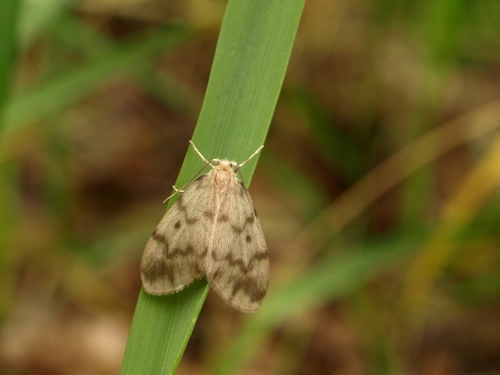
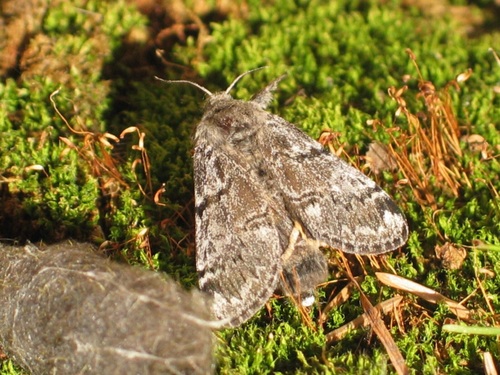
Gynaephora rossii Curtis, 1835 is a moth species with distinct physical traits across its life stages. Adult females have a forewing length of 17 mm, while males are slightly smaller. Males have light ochre yellow hindwings marked with a dark gray band along the wing edge, plus a light hair fringe extending from this edge. Females have dark brownish grey hindwings that also bear a band. Both sexes have mottled grey forewings crossed by jagged black lines. Both also have a small black disc-shaped dot surrounded by paler grey, and a black and pale grey mark near the forewing end, similar to the mark found on other Orgyiini. The antenna has tooth- or comb-like structures on both sides, which are larger in males than in females. Eggs of this species measure approximately 1.4 mm across. Caterpillars are densely covered in soft grey hairs, and carry seven pairs of yellow hair tufts on their back; most other Lymantriinae only have five pairs of these tufts. The species' cocoon is constructed from silk, with caterpillar hairs incorporated into its outer surface. It is oval-shaped, grey in color, and roughly the same size as a common silkworm cocoon. This is a day-flying moth that inhabits tundra in Arctic and Subarctic regions. It also occurs in rocky alpine tundra habitats on the summits of high mountains, and has been recorded flying in tree-containing muskeg habitat in Canada. It can survive in extreme environments, including at 2,200 m above sea level in the Suntar-Khayata Range and at 2,400 m in Buryatia. Confirmed recorded locations and altitudes include 1,561 m in Coös County, New Hampshire, 800 m in the Richardson Mountains, Yukon, Canada, and 300 m in Chukotka Autonomous Okrug, Russia. This species is assigned number 8290 in the List of moths of North America, commonly referred to as the MONA or Hodges number list.