About Gymnoschoenus sphaerocephalus (R.Br.) Hook.f.
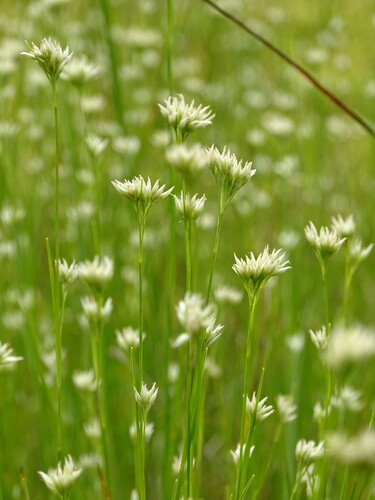
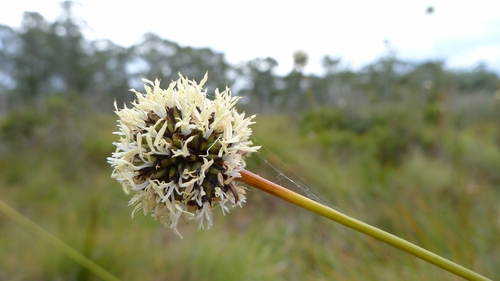
Gymnoschoenus sphaerocephalus, commonly called buttongrass, is a tussock-forming sedge species native to southeastern Australia. It contributes to a unique habitat in Tasmania. Scottish botanist Robert Brown first described this species as Chaetospora sphaerocephala in his 1810 publication *Prodromus Florae Novae Hollandiae et Insulae Van Diemen*; Joseph Dalton Hooker gave it its current accepted binomial name in 1858. G. sphaerocephalus is a perennial sedge that grows in clumps or tussocks. Its leaf blades grow up to 50 cm (20 in) long, and measure between 0.10–0.25 cm (0.04–0.1 in) wide. Round flowerheads emerge from the tussock on culms that can reach up to 1 m (3 ft) in height. These flowerheads are 1.5–2.0 cm (0.6–0.8 in) in diameter, and are composed of flattened 0.5 cm (0.2 in) long spikelets. Its root system consists of a mass of fleshy, carbohydrate-rich, edible rhizomes. In New South Wales, this species occurs from Gibraltar Range, and coastal Myall Lakes, south to Robertson. In Victoria, it has been recorded at just two confirmed locations: one in Beenak State Forest east of Melbourne, and one on the eastern side of Grampians National Park in western Victoria. It is far more abundant and widespread in Tasmania, where it is common across the western part of the state. G. sphaerocephalus grows in damp, nutrient-poor soils. In Tasmania, it forms low buttongrass grassland or moorland, where it is the dominant species. Associated primitive plant species include the club moss Lycopodiella lateralis, the spikemoss Selaginella uliginosa, and the ferns Gleichenia dicarpa and Gleichenia alpina. Even though buttongrass moorlands develop in wet climates, buttongrass itself is relatively flammable, and the entire ecological community is adapted to regular burning. The leaves of G. sphaerocephalus have the lowest recorded phosphorus content of any known plant species. The peat soil where it grows is acidic, with a pH ranging from 3.5 to 4.5. Buttongrass may form a symbiotic relationship with the burrowing crayfish Parastacoides tasmanicus: the crayfish aerates the soil through its burrows, and feeds on the buttongrass rhizomes in return. This sedge is also a food source for the critically endangered orange-bellied parrot, which breeds in southwestern Tasmania's buttongrass moorlands during the summer.