About Gymnorhinus cyanocephalus Wied-Neuwied, 1841
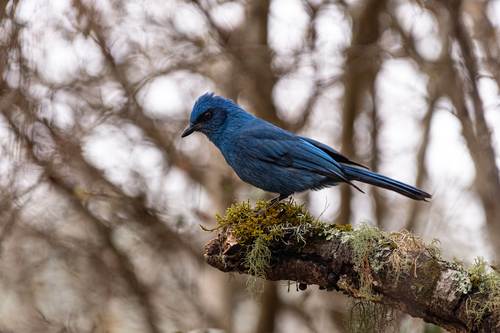
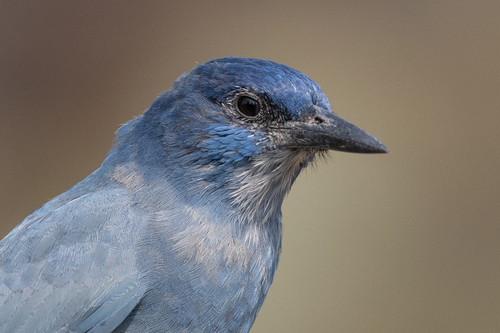
Gymnorhinus cyanocephalus, commonly called the pinyon jay, is a bluish-grey bird with deeper blue-grey coloration on its head, a whitish throat, and black bill, legs, and feet. In size, it is roughly intermediate between the blue jay and the Eurasian jay, and its overall body proportions are similar to Clark's nutcracker (Nucifraga columbiana); this similarity is considered convergent evolution, as both species fill similar ecological niches. The species was historically referred to as "blue crows".
Pinyon jays are resident breeding birds ranging from central Oregon to western South Dakota, south to northern Baja California, northwestern and east-central Arizona, central New Mexico, and western Oklahoma. They typically winter within their breeding range, but may occur irregularly outside this range from southern Washington to northwestern Montana, and south to Mexico and central Texas. When local pinyon seed crops are poor, pinyon jays may wander further to areas including central Washington, northwestern Oregon, northern Idaho, northwestern Montana, all of the Great Basin, Nebraska, Kansas, central-western and southwestern California, southeastern Arizona, central Texas, and northern Chihuahua. The species is classified as casual in Iowa, and there is one confirmed sighting reported from Saskatchewan.
Pinyon jays are permanent residents of pinyon-juniper (Pinus-Juniperus spp.) woodlands and low-elevation ponderosa pine (Pinus ponderosa) forests in the southwestern United States. Pinyon-juniper woodlands are primarily made up of Colorado pinyon (P. edulis) and Utah juniper (J. osteosperma), and cover large areas of Colorado, northern Arizona, Utah, and Nevada. Other pinyon and juniper species found in these woodlands include singleleaf pinyon (P. monophylla), Parry pinyon (P. quadrifolia), Mexican pinyon (P. cembroides), alligator juniper (J. deppeana), Rocky Mountain juniper (J. scopulorum), and California juniper (J. californica). Across its range, the pinyon jay relies on singleleaf pinyon in the northwestern portion and Colorado pinyon in the southeastern portion. The southwestern US ponderosa pine forests the species occupies include interior ponderosa pine (P. p. var. scopulorum) and Arizona pine (P. p. var. arizonica). In this text, "pinyon" refers to both Colorado pinyon and singleleaf pinyon, and "ponderosa pine" refers to interior ponderosa pine and Arizona pine, unless otherwise stated. Pinyon jays prefer pinyon-juniper woodlands and ponderosa pine forests, and share a mutualistic relationship with pinyon trees. Pinyon trees provide pinyon jays with food, nesting and roosting sites, and breeding stimuli. In turn, pinyon jays influence seed dispersal, the establishment of new trees, and the genetic structure of pinyon populations.
Colorado pinyon begins producing cones at 25 years of age, and produces substantial nut crops at intervals of 4 to 7 years, and sometimes every 3 to 5 years. Good cone crops tend to be localized, occur at irregular and infrequent intervals, but are synchronous across geographic areas, possibly as an adaptation to counteract seed predation. Bumper seed crops of Colorado pinyon are episodic and are likely linked to favorable climatic conditions. Singleleaf pinyon may not produce cones until it is 35 years old, with a 2- to 7-year interval between years of cone production. Maximum seed production for singleleaf pinyon occurs when trees are 75 to 100 years old.
Pinyon jays are specialized both in body structure and behavior to feed on pinyon seeds. Pinyon seeds are heavy and wingless, and not suited to wind dispersal, so they require animals including birds, other animals, and humans to spread their seeds. The seeds of both Colorado pinyon and singleleaf pinyon are very nutritious. Colorado pinyon seeds contain 14% protein, 62% to 71% fat, and 18% carbohydrate. Singleleaf pinyon seeds contain 10% protein, 23% fat, and 54% carbohydrate. Both contain all essential amino acids, plus abundant phosphorus, iron, vitamin A, and other nutrients. Pinyon cones require 3 growing seasons to fully mature, but seeds within 1-year-old green cones can be eaten by pinyon jays and are ripe by the end of August. Each pinyon cone holds approximately 20 seeds. Ponderosa pine seeds are also an important food source for pinyon jays.
In addition to pinyon and ponderosa pine seeds, pinyon jays also eat Rocky Mountain bristlecone pine (Pinus aristata) seeds, limber pine (P. flexilis) seeds, and juniper berries. Insects including caterpillar (Lepidoptera) larvae, beetles (Coleoptera), grasshoppers (Orthoptera), and ants (Hymenoptera) make up a large portion of the species' diet. Spiders (Araneae) are commonly eaten, and cultivated grains including corn, sorghum, beans, barley, oats, and wheat are consumed during the winter. Pinyon jays have also been observed ingesting soil around cattle salt blocks. Nestling pinyon jays eat insects, soft plants, and pinyon seeds when seeds are plentiful.