About Gymnopus dryophilus (Bull.) Murrill
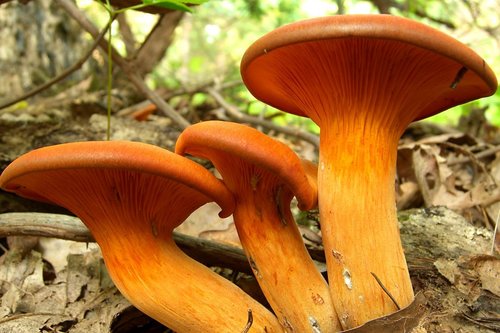
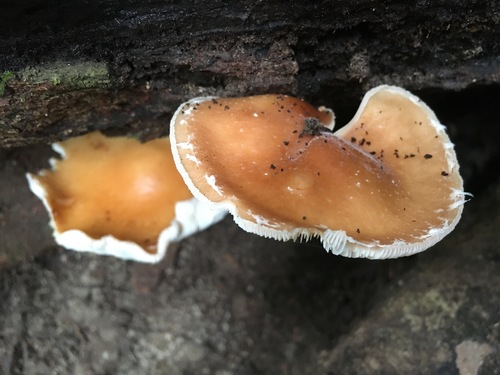
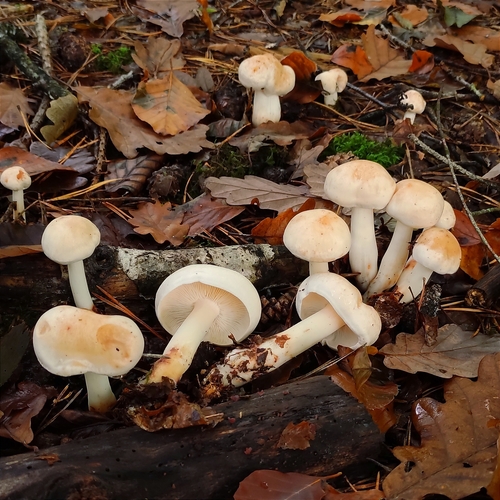
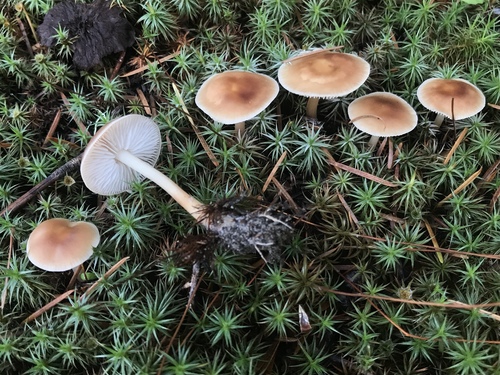
The cap of Gymnopus dryophilus measures 2–6 centimetres (3⁄4–2+3⁄8 inches) in diameter, is convex in shape, and ranges in color from reddish-brown to ochre, fading to tan when dry. Caps become more irregular in shape as the mushroom ages. The gills are whitish, crowded, only thinly attached to the stem, and detach from the stem with age. Spore print is white, and buff-colored spores do not react to Melzer's reagent. The smooth (bald) stem is 2–8 cm (3⁄4–3+1⁄8 inches) long, 3–6 mm (1⁄8–1⁄4 inch) in diameter, and is sometimes thicker at the base. This mushroom has a palatable taste. Under microscopic examination, spores are 6×3 μm in size, slightly tear-shaped, and lobed club-shaped cystidia measure 15–50 μm × 2–6 μm. Hyphae of the cap cuticle may also have lobes. There is ongoing debate that G. dryophilus actually forms a complex of multiple distinct species, with several proposed new species (including G. brunneolus, G. earleae and G. subsulphureus) that should be split from the original taxon. These split species are not generally recognized by the scientific community at present. G. dryophilus may be infected by the parasite Syzygospora mycetophila, which causes pale outgrowths to form on the mushroom’s surface. This fungus is very common in Northern Hemisphere temperate woodlands, so abundant that it is sometimes referred to as a "weed" mushroom. It produces fruiting bodies from April to December, and is often visible when few other fungal species are present. While its specific epithet dryophilus translates to "lover of oak trees", it can also be found growing with other broad-leaved trees and conifers. It grows in arcs and fairy rings in oak and pine woods, or in clusters on wood chip mulch, from May to October.