About Gymnopilus luteus (Peck) Hesler
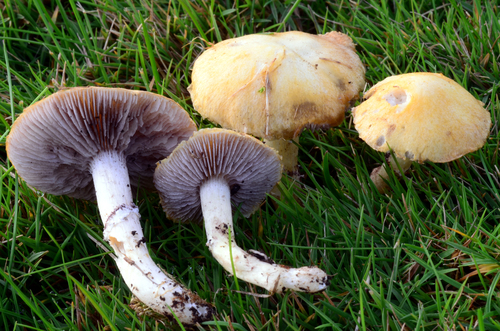
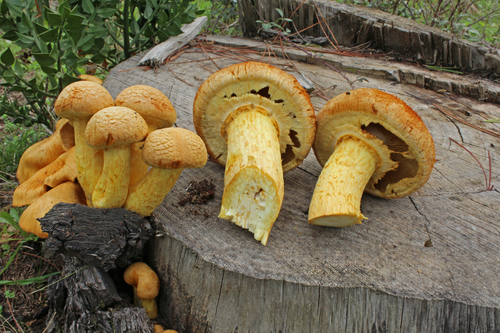
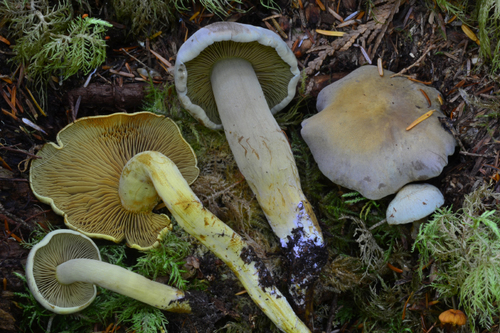
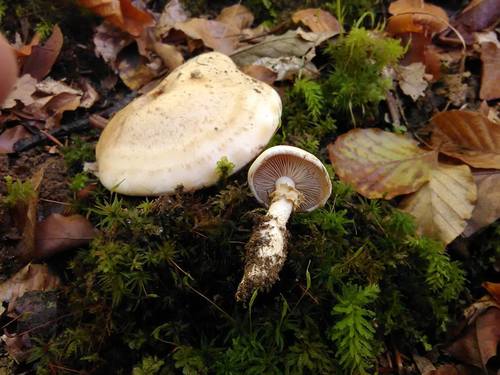
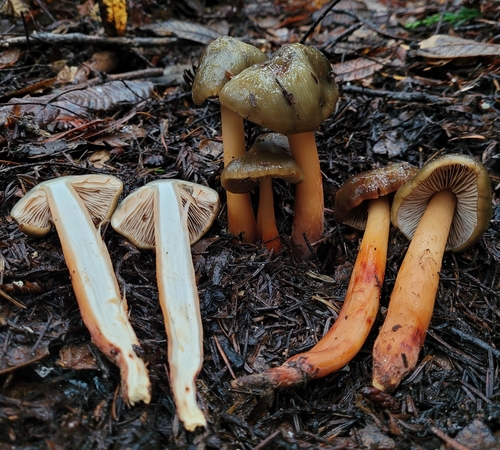
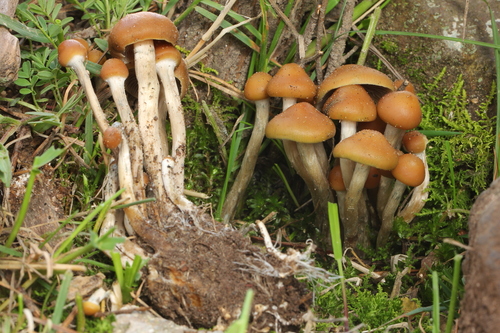
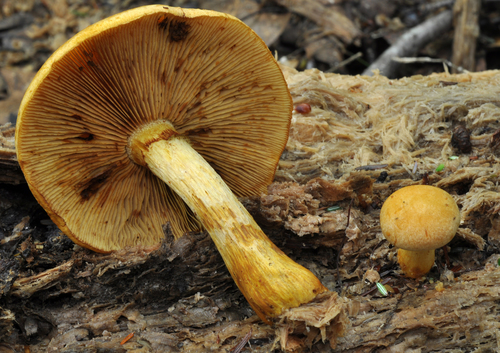
Gymnopilus luteus (Peck) Hesler has a 3–20 cm wide cap that starts out convex-hemispherical, expanding to broadly convex. Its margin is irregularly infolded (not incurved), and extends slightly past the gills. Cap color ranges from buff yellow to warm buff orange, often slightly darker toward the center; it is dry, smooth, silky or finely floccose-fibrillose, and sometimes floccose-squamulose toward the center. The cap flesh is firm and pale yellow, and stains orange-brown or sometimes bluish-green when injured or with age. The gills are adnexed, thin, and closely spaced. They start pale yellow, turning rusty brown as the mushroom matures. The spore print is rusty brown. The stipe measures 4–10 cm long and 0.5–3 cm thick, and ranges from equal in width along its length to slightly enlarged near the base. It is solid and firm, matching the cap in color, and develops yellowish-rusty stains when handled. The stipe surface is finely hairy. The partial veil typically forms a fragile submembraneous ring or a fibrillose annular zone near the stipe apex. Like the cap, the stipe stains orange-brownish or sometimes bluish-green when injured or with age. This species has a very bitter taste. The gills produce a strong anise odor, which is one of the easiest traits to distinguish it from close relatives. Microscopically, spores are elliptical, measuring 6.5–8.3 μm by 4.5–5.7 μm, averaging 7.4 ± 0.5 by 5.1 ± 0.3 μm. They are minutely warty, slightly dextrinoid, and finely roughened with irregular warts and short ridges, with no germ pore. Pleurocystidia are absent or very rare. Most cheilocystidia are lageniform to lecythiform, though occasionally they do not have a swollen apex; they measure 19.3–35.4 μm long, averaging 27.3 ± 4.0 μm. Caulocystidia are abundant above the annular zone, formed as terminal cells of long hair-like hyphae. They range from narrowly ventricose–capitate to cylindric–capitate, and are often cylindrical to clavate with no significant apical swelling; they measure 30.9–66.9 μm. Clamp connections are present. Bruising from injury ranges from no change to light blue or green, most often at the stipe base and sometimes on the cap, and occurs more commonly on aborted pins. Its bruising reaction is slower than that of most Psilocybe species. Dried G. luteus contains 0.1–0.5% total tryptamines, with lower levels of psilocin and psilocybin compared to species in the genus Psilocybe. It is considered inedible due to its very bitter taste and the presence of the hallucinogenic compounds psilocybin and psilocin. Gymnopilus luteus grows solitary, gregariously, or in small clusters on dead hardwood trees, preferring damp, well rotted wood. It fruits from June to November, and is widely distributed in eastern United States and Canada.