About Gymnopilus luteofolius (Peck) Singer
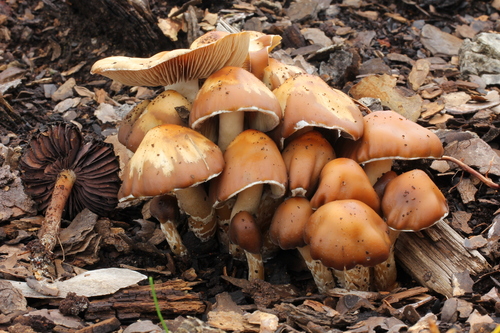
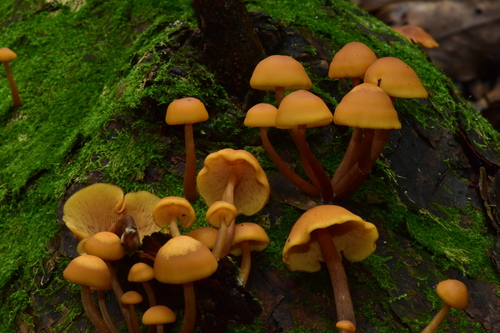
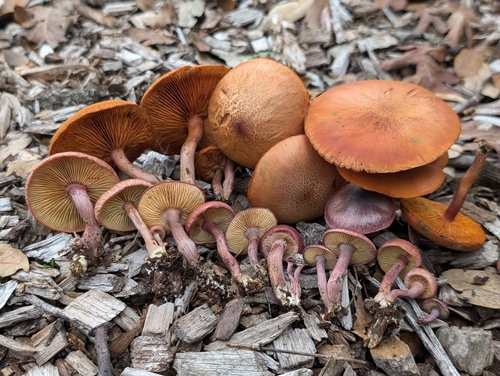
The fruit bodies of Gymnopilus luteofolius have caps 2 to 11 centimetres (3⁄4 to 4+1⁄4 inches) in diameter that range in color from reddish to purplish to yellow, and can stain bluish-green. The cap surface is covered with clustered fasciculate scales: these start out purplish, quickly fade to brick red, and finally fade to yellow as the mushroom matures. The internal context tissue is reddish to light lavender, fading to yellowish as the mushroom matures. The gills have adnate attachment to the stipe; they start off yellow, turning rusty brown as spores mature. The stipe matches the cap in color, is often dusted with rusty-brown spores, and is fibrillose. It measures 3–9 cm long by 3–10 mm thick, and is roughly equal in width along its length or enlarged near the base. The stipe often has greenish stains near its base. This mushroom has a bitter taste. Spore deposits are bright rusty brown; individual spores measure 6–8.5 x 4–4.5 μm, are ellipsoid to subellipsoid, inequilateral, roughened, and dextrinoid, with no germ pore. Basidia are 4-spored and measure 24–28 x 6–7 μm. Basidioles are often brown. Pleurocystidia, cystidia on the gill face, measure 30–38 x 5–10 μm; they are hyaline, and shaped fusoid to subventricose. Cheilocystidia, cystidia on the gill edge, measure 23–28 x 4–7 μm; they are shaped ventricose to flask shaped, and often capitate. The lamellar trama is made of parallel hyphae 5–18 μm across, which are frequently septate and contain yellowish pigment that dissolves in potassium hydroxide. The pileus trama is interwoven, and the pileus cuticle has brown tufts of brown incrusted hyphae. Pileocystidia measure 44–53 μm; they are club-shaped, cylindrical, or ventricose terminal elements on the hyphae that form the cap scales. Caulocystidia, cystidia on the stipe, measure 20–63 x 3–15 μm, and are shaped club, ventricose, or flask. Gill trama and pileus trama are pale yellowish-brown in KOH and reddish brown in Melzer's reagent. Clamp connections are present. This species grows in dense clusters on dead hardwood and conifer wood in North America, where it is common. It generally fruits from June to October across most of the region, and from September to March on the West Coast. Its edibility is unknown. Mycologist David Arora notes that the related species G. aeruginosus is psychoactive.