About Gymnopilus junonius (Fr.) P.D.Orton
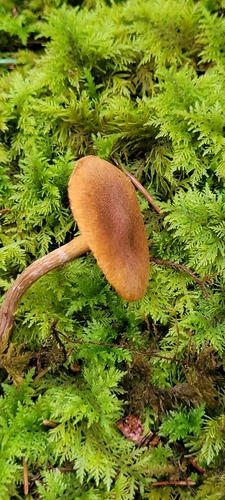
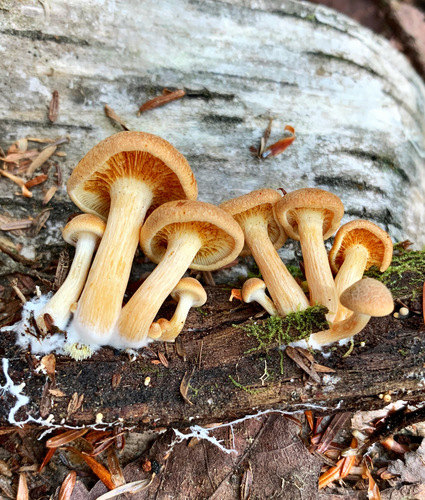
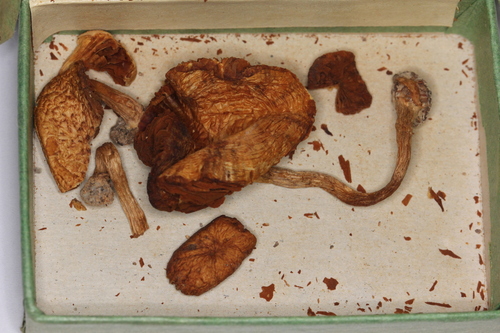
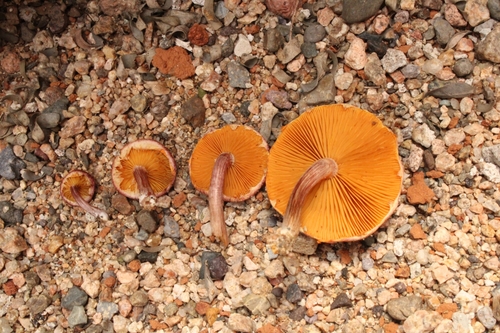
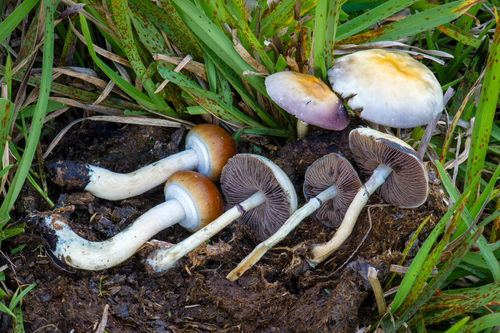
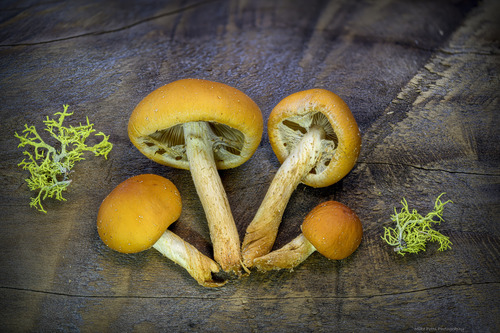
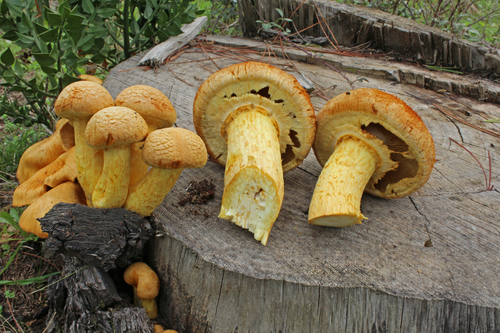
This species, scientifically known as Gymnopilus junonius (Fr.) P.D.Orton, has a cap that measures 5–30 cm (2–12 in) across. The cap starts out bun-shaped, and later develops from convex to flat. Younger specimens have bright yellow-orange caps, while older specimens have orange-brown or reddish brown caps, and the cap surface is dry and scaly. The mushroom's flesh is yellow, it has a mild odor, and a bitter taste. The stem is 5–25 cm (2–10 in) long, 1–5 cm thick, and often narrows near its base. The mushroom has a frail ring that is dusted with rusty orange spores, and its gills attach to the stem in an adnate to sub-decurrent arrangement. The mushroom stains red when exposed to KOH, and turns green when cooked. Its spore print is rusty brown. Unlike its psychoactive relatives in the Psilocybe genus, G. junonius does not contain psilocybin and does not stain blue, though smaller specimens occasionally show bruising. This mushroom typically grows in clusters ranging from several to several dozen individuals, but it sometimes grows alone. It is considered inedible because of its bitter taste. Gymnopilus junonius is distributed across Europe, Australasia, and South America. It grows in dense clusters on hardwood and conifer stumps and logs. It is most commonly found in moist, lowland wooded areas located near rivers. This species does not grow naturally in North America, where similar mushrooms are often misidentified as it.