About Gymnapistes marmoratus (Cuvier, 1829)
Dorsal Fin Structure
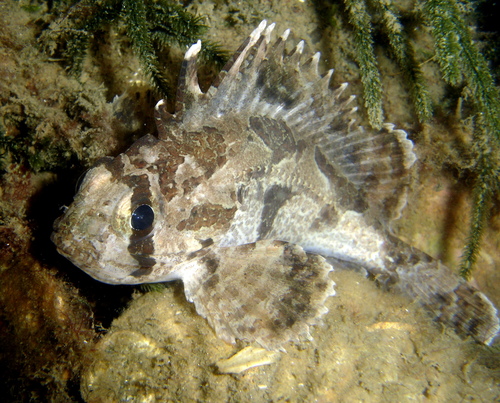
Gymnapistes marmoratus, commonly called the South Australian cobbler, has a long-based dorsal fin containing 12 or 13 spines, with each spine separated by an incision in the connecting membrane; the fin also has between 7 and 10 soft rays, and the spiny and soft-rayed parts of the dorsal fin are separated by an incision.
Anal Fin Structure
The species has 3 spines and 4 to 6 soft rays in its anal fin.
Head Morphology
Its eye does not bulge above the dorsal profile of the head. The intraorbital space is slightly concave, and there are several obvious spines on the head.
Lacrimal Bone Features
The lacrimal bone is mobile; it bears a large, curved, erectile spine on its posterior side, and a smaller spine on its anterior side.
Scaling
The only scales this fish has are located on the lateral line.
Body Coloration
The South Australian cobbler has a mottled color pattern: the upper body is covered in brown to dark brown blotches that fade to a pale color on the ventral side. These blotches are less distinct in larger individuals.
Fin Markings
There is a clearly visible dark blotch on the dorsal fin between the 4th and 7th spines. A dark, oblong spot sits near the base of the pectoral fin, while the other fins often display vermiculations or faint, unclear spotting.
Maximum Size
This species reaches a maximum total length of 22.5 cm (8.9 in).
Geographic Distribution
This fish is endemic to the temperate southern coasts of Australia. Its range extends from the central coast of New South Wales to Perth, Western Australia.
Habitat and Depth Range
It inhabits shallow inshore waters, tidal pools, and estuaries at depths between 0.25 m (9.8 in) and 35 m (114 ft 10.0 in), and lives in seagrass beds.