About Gymnanthemum capense (A.Spreng.) J.C.Manning & Swelank.
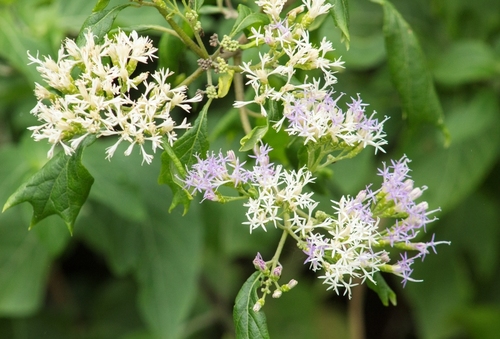
Scientific name: Gymnanthemum capense (A.Spreng.) J.C.Manning & Swelank. The species previously known as Gymnanthemum mespilifolium is a sprawling woody liane reaching up to 15 cm thick. It is native to Southern Africa, found in the Eastern Cape, KwaZulu-Natal, Limpopo, Mpumalanga, and Western Cape. It grows as a vigorous pioneer species in disturbed or degraded habitats, including cleared areas and forest margins. The genus name Gymnanthemum comes from the Greek words gymnos meaning naked and anthos meaning flower, which refers to the lack of paleae on the receptacle. The former specific epithet mespilifolium means leaves that resemble those of the genus Mespilus. The genus Gymnanthemum contains around 43 species. These species are native to sub-Saharan Africa, Madagascar, and Southern Asia, and have been introduced into Brazil. Gymnanthemum was first formally described by Cassini in 1817. It was later merged into the genus Vernonia by Candolle in 1836 and again by Bentham in 1873. The genus was finally resurrected by Robinson and Kahn in work published between 1986 and 1999. The current accepted taxonomic boundaries of the genus are narrower than they were in 1999. Currently, nine species of Gymnanthemum are recognized in southern Africa. Five of these species are endemic to South Africa. The remaining four more widespread species are Gymnanthemum theophrastifolium (Schweinf. ex Oliv. & Hiern) H. Rob., Gymnanthemum coloratum (Willd.) H. Rob. & B. Kahn, Gymnanthemum amygdalinum (Del.) Sch. Bip. ex Walp. and Gymnanthemum myrianthum (Hook. f.) H. Rob. In the South African Journal of Botany Volume 102, January 2016, pages 81–101, N. Swelankomo, J.C. Manning and A.R. Magee proposed reclassifying Gymnanthemum mespilifolium into the new combination Gymnanthemum capense.