About Gymnadenia conopsea (L.) R.Br.
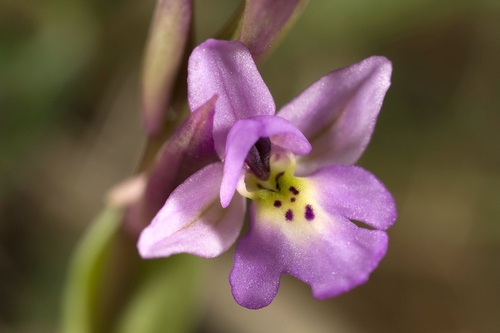
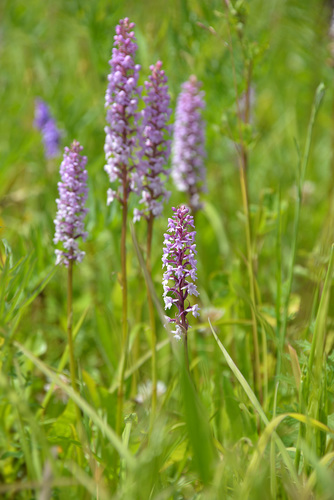
Gymnadenia conopsea (L.) R.Br. has an average height of 20–60 centimeters (7.9–23.6 inches), and can reach a maximum height of 80 centimeters (31 inches). These plants are tuberous geophytes, meaning their buds develop in underground tubers that produce new stems, leaves, and flowers each year. As terrestrial orchids, they do not grow on large other plants, unlike epiphytic orchid species. Its stem is leafy, robust, and has a striated surface. This orchid produces between 3 and 7 long, narrow, lanceolate gray-green leaves; individual leaves measure 1 to 2 cm wide and 10 to 25 cm long. It has two ovoidal tubers that measure 1 to 3.5 cm, are deeply webbed, and bear many small, short lobes. The inflorescence is 5–25 centimeters (2.0–9.8 inches) long, made up of flowers clustered in dense cylindrical spikes, with up to 50 flowers per spike. These inflorescences are scented, and the genes that control production of eugenol, a volatile scent compound, have been identified in Gymnadenia conopsea, G. odoratissima, and G. densiflora. The flowers are petiolated, grow in the axils of long bracts, and reach an average size of 0.8–1.4 centimeters (0.31–0.55 inches). Each flower has a distinctive three-lobed lip and long spurs, with a light scent similar to cloves. Flower color ranges from white and pink to pink-purple; white flowers occur more rarely. Flowering occurs in summer, from June to July. The flowers are hermaphrodite and pollinated by insects (entomophily), including moths. This species is quite common across most of northern Europe, with the exception of the Dinaric Alps. In Asia, it is common in areas north of the Himalayas. Gymnadenia conopsea ssp. borealis was recorded in County Donegal, Ireland in 2004. Its habitat includes mountain meadows, pastures, grassland, and fens. It grows on mildly damp, low-nutrient siliceous and calcareous substrates, at altitudes between 0 and 2,400 meters (0 and 7,874 feet) above sea level. This species is almost exclusively pollinated by moths (Lepidoptera). Its most common pollinators are the small elephant hawk-moth (Deilephila porcellus), hummingbird hawk-moth (Macroglossum stellatarum), silver Y (Autographa gamma), burnished brass (Diachrysia chrysitis), and large yellow underwing (Noctua pronuba). Its average fruit set is high at 73%. Seed germination depends on the presence of mycorrhizal fungi. Gymnadenia conopsea is considered a mycorrhizal generalist, able to form associations with a variety of different fungal species, including species in Tulasnellaceae, Ceratobasidiaceae, and Pezizales.