About Gyalolechia fulgens (Sw.) Søchting, Frödén & Arup
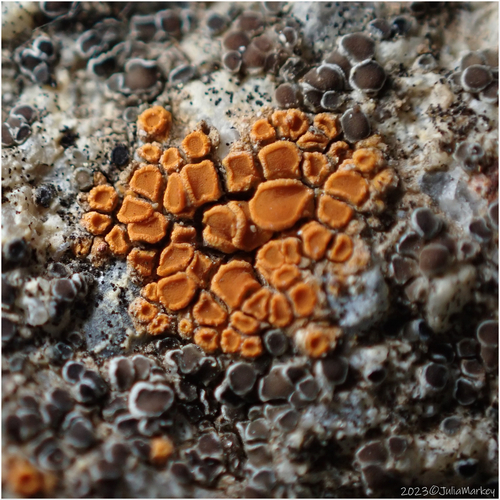
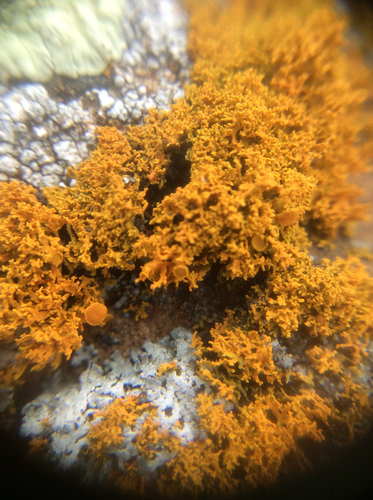
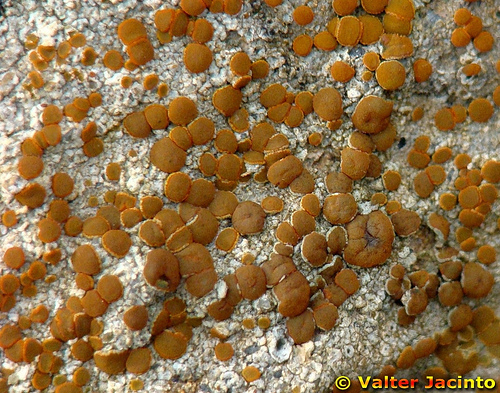
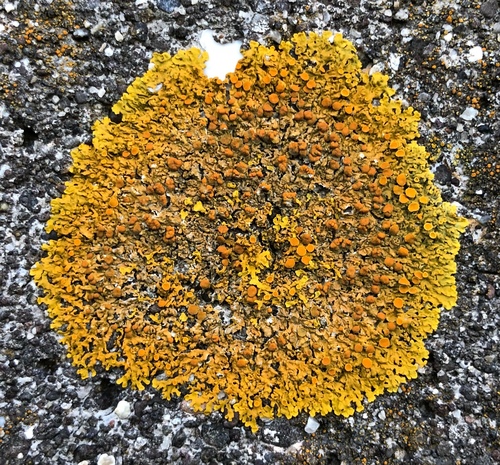
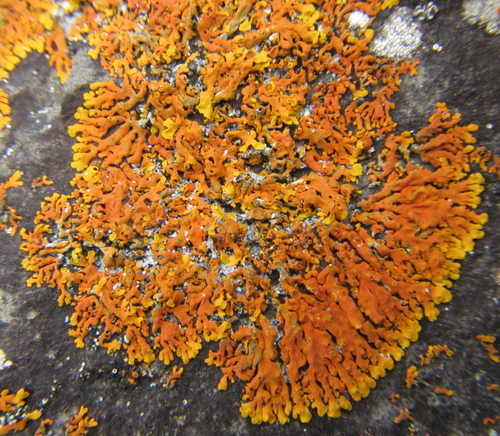
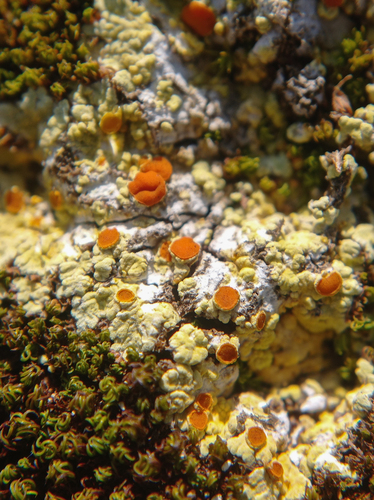
Gyalolechia fulgens (Sw.) Søchting, Frödén & Arup is a lichen with a distinctive appearance and colouration that makes it easily identifiable. The main body of the lichen, called the thallus, usually grows to between 1 and 3 cm in diameter. It ranges in colour from vibrant orange-yellow to whitish, and forms a rosette-like shape, though it can also grow as an irregular, fragmented structure. The thallus is placodioid, meaning it has a crust-like centre with lobes that radiate outward. Its marginal lobes are clearly defined, usually longer than they are broad, and most often over 1 mm wide. These lobes stay distinct from one another or overlap, especially close to the centre of the thallus. As the lichen matures, the central area often develops a verrucose-bullate texture marked by wart-like protrusions, and becomes covered in a coarse layer of pale, powdery substance called pruina. Specialised scale-like reproductive propagules called schizidia are present to varying degrees on the surface of Gyalolechia fulgens; many populations produce these structures across part of the thallus surface. When schizidia are shed, they expose the underlying white medulla, the inner layer of the thallus. Spore-producing structures called apothecia are common on this lichen. They are small, measuring 0.5 to 1.5 mm in diameter. They start out concave, with a surrounding rim-like structure called a thalline exciple, and become convex over time as the margin becomes more or less excluded. The deep orange colour of the apothecia stands out against the paler colour of the thallus. The ascospores of Gyalolechia fulgens measure 9 to 12 by 3.5 to 5 μm, and are usually either non-septate with no internal divisions, or one-septate with a single division. They can be ellipsoid, or oval; pyriform, or pear-shaped; or clavate, or club-shaped. Chemical spot tests produce characteristic reactions for this species. A potassium hydroxide (K) test turns the thallus purple, which indicates the presence of the secondary lichen metabolites parietin and its precursor emodin. Under ultraviolet light, the thallus glows a dull pale orange due to the presence of fragilin and caloploicin. The apothecia also turn purple in the K test, which indicates the presence of physcion. Gyalolechia fulgens typically grows in well-lit environments with well-drained, basic substrates. It grows best on stable, firm surfaces such as chalk grasslands and compacted shell-sand. It is often found in warm, sheltered open locations, and favours sites near sea level, frequently adjacent to dunes. A notable feature of its habitat is its association with certain moss species, especially Trichostomum crispulum. Geographically, Gyalolechia fulgens has a wide distribution. It occurs across Europe and is widespread in warmer regions of the Northern Hemisphere. It is also found in Australia and New Zealand. In the United Kingdom, it is classified as rare, and in Wales it is restricted to coastal areas. Gyalolechia fulgens is part of a group of specialised lichens that grow in highly open environments that usually have areas of exposed soil and often include small rock outcrops. These settings have very little competition from larger vascular plants, giving the lichen enough space and resources to grow. It is a prominent component of biological soil crust lichen communities in the Negev desert, and is particularly common on north-west facing slopes and interdunes. In North America, it occurs in the interior of the continent, with a range that extends north to the Arctic.