About Gutierrezia sarothrae (Pursh) Britton & Rusby
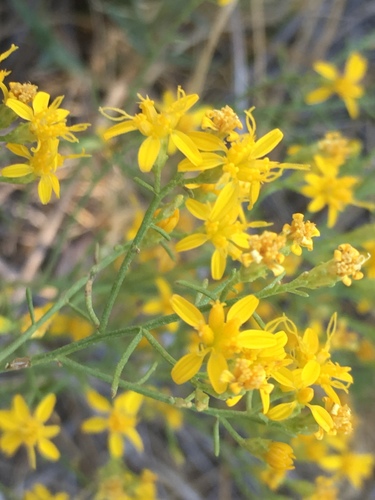
Gutierrezia sarothrae is a perennial subshrub that usually grows 10 to 60 centimeters (4 to 24 inches) tall, and may occasionally reach 100 cm (39 inches) in height. Its stems are brown at the base, and green to tan in color on the upper parts of the plant. Stems branch freely from the woody caudex at the base to form a rounded shape. The stems die back during dormancy, which gives the plant a broom-like appearance. Stems range from smooth to covered in short hairs, and may be resinous and sticky to the touch. Since all stems are roughly the same length, the plant often looks domed or fan-shaped when it flowers. The leaves are alternate and linear, measuring 5 to 63 millimeters (1⁄4 to 2+1⁄2 inches) long and 1 to 3 mm (1⁄16 to 1⁄8 inch) wide. Lower leaves are typically shed before the plant blooms. In its first growth year, the plant develops a long, woody taproot, and produces numerous lateral roots as it matures. Dense clusters holding 3 to 7 small yellow ray flowers and 2 to 6 tiny disk flowers grow 3–6 mm (1⁄8–1⁄4 in) long at the ends of stems, blooming from mid-July to September. Various insects pollinate the flowers, which produce an oval fruit covered in chaffy scales. The plant reproduces by seed; its seeds are light, densely hairy, and dispersed by wind. A single plant can produce over 9,000 seeds each year, though most ripe seeds fall directly beneath the parent plant. Seeds can stay viable in soil for several years, and have remained viable for at least two years under laboratory conditions. G. sarothrae is often confused with rabbitbrush, but can be told apart by its ray flowers, which rabbitbrush does not have. It is also similar to littlehead snakeweed (G. microcephala), which only produces 1–3 of both ray and disk flowers. G. sarothrae is a native North American plant, found across west-central Canada (the Prairie Provinces), western and central United States (the Great Plains and regions west of the Great Plains), and northern Mexico as far south as Zacatecas and Baja California Sur. Thanks to its efficient water use and drought tolerance, it can survive in arid and semi-arid sites including rocky plains, dry foothills, ridgetops, mountain slopes, and semi-desert valleys. This very adaptable species grows in a wide range of ecoregions, including pinyon–juniper woodlands, desert shrublands, and sagebrush-grasslands. It can grow in many different soil types in full sun with good drainage, but grows best in clay loams on alluvial slopes, and shallow, rocky, or sandy soil, and grows poorly in saline or alkaline soils. G. sarothrae is low-quality browse for most large ungulates. It is an important food source for pronghorn antelope in some areas, especially during spring and summer, and can make up as much as 28% of a pronghorn antelope's diet. It has little value as forage for cattle and horses, but can be fair-quality winter browse for domestic sheep when green forage is not accessible. Under natural conditions, G. sarothrae quickly invades disturbed areas and can reduce soil erosion; for example, it is known to stabilize loose windblown soils in mesquite sand dunes. The U.S. Fish and Wildlife Service has rated its erosion control potential as low to medium, its short-term revegetation potential as low, and its long-term revegetation potential as low to medium. G. sarothrae can be toxic to domestic sheep, goats, and cattle when eaten in large amounts, though domestic goats have moderate resistance to its effects. Its toxicity comes primarily from saponins, which can cause illness, death, or abortion, and it also contains alkaloids, terpenes, and flavonols. The species is also a facultative absorber of selenium, which can cause illness or death when consumed in large quantities. As little as 9 kilograms (20 pounds) of fresh G. sarothrae eaten by cattle over seven days can cause miscarriages, and consumption of ten to 20% of an animal's body weight over two weeks can cause death in cattle, sheep, and goats. Toxicity is generally higher during periods of rapid growth, such as early leaf development, and when the plant is grown on sandy soils rather than calcareous or clay soils. G. sarothrae was used for various purposes by Native Americans of the Great Plains. The Comanche bound its stems together to make brooms. The Blackfoot used its roots in an herbal steam to treat respiratory ailments. The Lakota used a decoction of the plant to treat colds, coughs, and dizziness, while the Dakota used a concentrate made from the flowers as a laxative for horses. The Navajo rubbed the plant's ashes on their bodies to treat headaches and dizziness, and also applied chewed plant material to wounds, snakebites, and swollen areas from insect bites and stings. The Zuni used an infusion of the blossoms as a diuretic and to "make one strong in the limbs and muscles", and used an infusion of the whole plant topically for muscle aches. Also called broom snakeweed, this species is grown as a garden plant in xeriscaping for its showy late-season blooms. Plants are propagated by seed and do not require cold stratification. Since it is unpalatable to herbivores, it is resistant to damage by deer.