About Gulo gulo (Linnaeus, 1758)
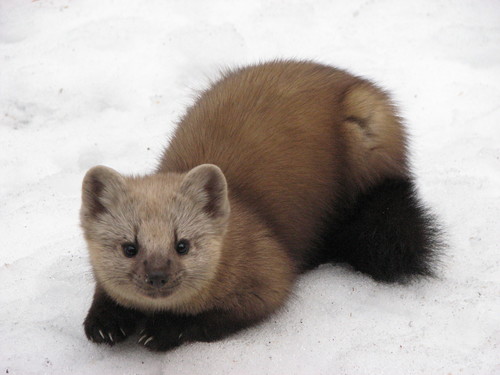
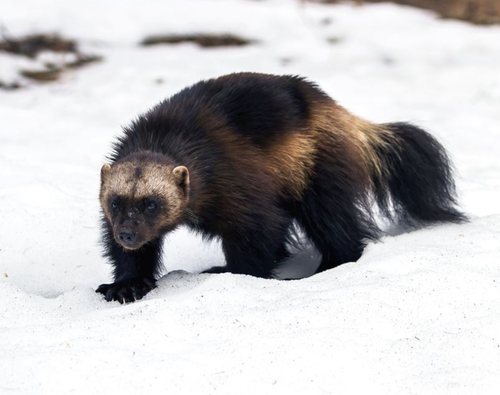
Gulo gulo, the wolverine, is an elongated, low-to-the-ground animal with strong limbs, a broad rounded head, small eyes and short rounded ears. It most closely resembles a large fisher. Though its legs are short, its large five-toed paws with crampon-like claws and plantigrade posture let it climb and cross steep cliffs, trees and snow-covered peaks with relative ease.
Adult wolverines are about the size of a medium dog, with a body length of 65–109 cm (26–43 in), a shoulder height of 36–45 cm (14–18 in), and a tail length of 17–26 cm (6+1⁄2–10 in). Males usually weigh 11–18 kg (24–40 lb), while females weigh 8–12 kg (18–26 lb). Soviet literature references exceptionally large males reaching up to 32 kg (71 lb), but Mammals of the Soviet Union considers these weights improbable. Males are often 10–15% larger than females in linear body measurements, and can be 30–40% heavier. Some sources claim Eurasian wolverines are larger and heavier than North American wolverines, reaching up to 20 kg (44 lb), but this may refer specifically to areas like Siberia, as data from Fennoscandian wolverines shows they are typically around the same size as North American individuals.
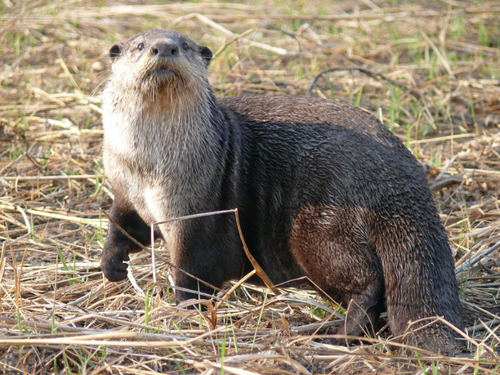
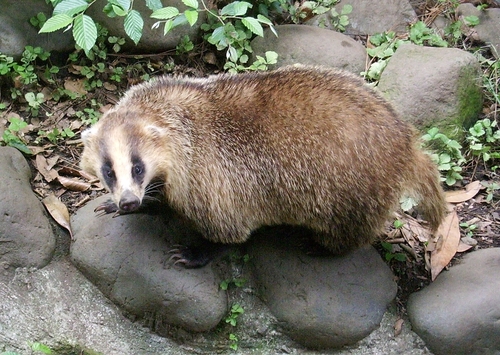
The wolverine is the largest terrestrial mustelid. Only the marine-dwelling sea otter, the Amazon basin's giant otter, and the semi-aquatic African clawless otter are larger, while the European badger may reach a similar body mass, especially in autumn.
Wolverines have thick, dark, oily, highly hydrophobic fur that resists frost. This trait made it traditionally popular among hunters and trappers for use as a lining for jackets and parkas in Arctic conditions. Some individuals have a distinct light silvery facial mask, and a pale buff stripe runs laterally from the shoulders along the side, crossing the rump just above a 25–35 cm (10–14 in) bushy tail. Some individuals have prominent patches of white hair on their throats or chests.
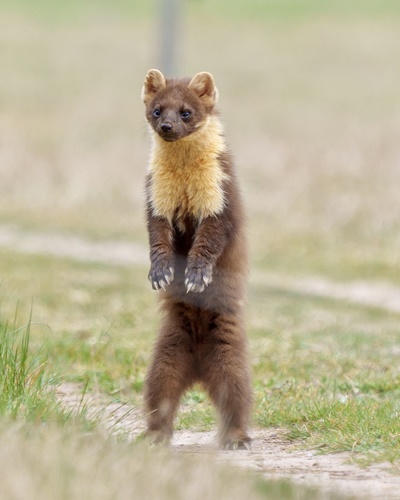
Like many other mustelids, wolverines have potent anal scent glands used to mark territory and for sexual signaling. The pungent odor has earned the species the nicknames "skunk bear" and "nasty cat." Analysis of anal gland secretion samples from six individuals found the composition is complex and variable: 123 compounds were detected in total, with 45 to 71 compounds per individual. Only six compounds were present in all extracts: 3-methylbutanoic acid, 2-methylbutanoic acid, phenylacetic acid, alpha-tocopherol, cholesterol, and a compound tentatively identified as 2-methyldecanoic acid. The highly odorous thietanes and dithiolanes found in anal gland secretions of some Mustelinae members including ferrets, mink, stoats, weasels (Mustela spp.) and zorillas (Ictonyx spp.) were not observed in wolverine secretion. The composition of wolverine anal gland secretion is similar to that of two other Mustelinae members, the pine marten and beech marten (Martes spp.).
Like other mustelids, wolverines have a special upper molar at the back of the mouth that is rotated 90 degrees toward the inside of the mouth. This adaptation allows wolverines to tear meat from frozen prey or carrion. Among all carnivore mammals, wolverines have the highest compressive strength per trabecular bone volumetric fraction (measured on a 10mm high × 5mm cylinder at the mandibular condyle), at 940.8 Newtons. This is followed by cheetah at 784.4 Newtons, Malagasy civet at 714.4 Newtons, honey badger at 710.8 Newtons, and kinkajou at 693.2 Newtons.
Wolverines live primarily in isolated arctic, boreal, and alpine regions of northern Canada, Alaska, Siberia, and Fennoscandia. They are also native to European Russia, the Baltic countries, the Russian Far East, northeast China and Mongolia. Wolverine remains have been found in Ukraine, but the species was extirpated there, and it is unclear whether wolverines ever formed sustainable populations in the area. Unique encounter records exist for Latvia, with the most recent recorded in late July 2022, though this record is disputed due to unclear footage. Wolverines were widespread in Latvia in the 16th and 17th centuries, but are no longer native to the area.
Most New World wolverines live in Canada and Alaska. Historically, wolverines were also present in Colorado, areas of the southwestern United States (Arizona and New Mexico), the Midwest (Indiana, Nebraska, North Dakota, South Dakota, Ohio, Minnesota, and Wisconsin), New England (Maine, New Hampshire, Vermont, and Massachusetts), and in New York and Pennsylvania. In the Sierra Nevada, wolverines were sighted near Winnemucca Lake in spring 1995 and at Toe Jam Lake north of the Yosemite border in 1996; they were later photographed by baited cameras near Lake Tahoe, including in 2008 and 2009. According to a 2014 U.S. Fish and Wildlife Service publication, wolverines are found in the North Cascades in Washington and the Northern Rocky Mountains in Idaho, Montana, Oregon (Wallowa Range), and Wyoming. Individual wolverines have also moved into historic range in the Sierra Nevada Mountains of California and the Southern Rocky Mountains of Colorado, but have not established breeding populations in these areas. In 2022, Colorado Parks and Wildlife considered plans to reintroduce wolverines to the state. Wolverines are also present in Utah but very rarely seen, with only six confirmed sightings since the first confirmed sighting in 1979. Three of these six confirmed Utah sightings have been caught on video. In 2022, a male wolverine was captured and tagged in Utah before being released back into the wild to help researchers better understand the species' range. In August 2020, the National Park Service reported wolverines had been sighted at Mount Rainier, Washington, for the first time in more than a century. The sighting was of a reproductive female and her two offspring. In 2004, the first confirmed wolverine sighting in Michigan since the early 19th century occurred when a Michigan Department of Natural Resources wildlife biologist photographed a wolverine in Ubly, Michigan. A wolverine specimen was found dead at the Minden City State Game Area in Sanilac County, Michigan, in 2010.
Wolverines are induced ovulators. Successful males form lifetime relationships with two or three females, which they visit occasionally, while other males remain without a mate. Mating season occurs in the summer, but actual implantation of the embryo (blastocyst) in the uterus is delayed until early winter, slowing fetal development. Females often do not produce young if food is scarce. The gestation period is 30–50 days, and litters of typically two or three young (called "kits") are born in the spring. Kits develop rapidly, reaching adult size within the first year. The typical longevity of a wolverine in captivity is around 15 to 17 years, while the average lifespan in the wild is more likely between 8 and 10 years. Fathers visit their offspring until the kits are weaned at 10 weeks of age. Some offspring reconnect with their fathers when they are around six months old, and travel together for a period of time.