About Guilandina bonduc L.
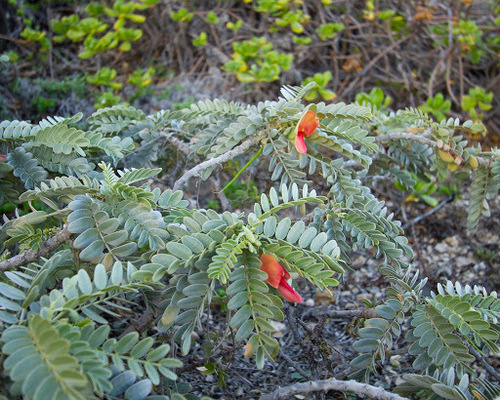
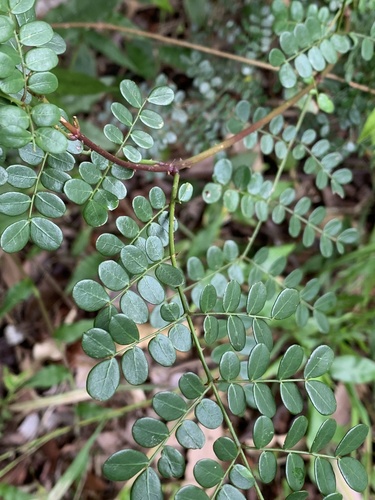
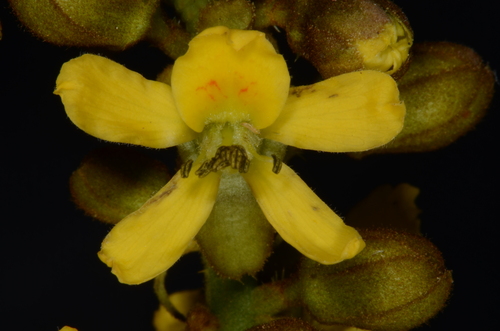
Guilandina bonduc L. grows as a scrambling shrub or climbing vine, reaching up to 8 meters (30 feet) in length. Its stems are irregularly covered with curved prickles. The leaves are large and bipinnate, growing up to 40 cm (16 inches) long, with scattered prickles along the leaf rachises and leaf blades. Each leaf holds four to eleven pairs of pinnae, which measure 5 to 20 cm (2 to 8 inches) long, and each pinna holds five to ten pairs of pinnules. The pinnules are 15 to 40 mm (0.6 to 1.6 inches) long, with elliptic, oblong, or ovate shapes, acute tips, and entire margins. Its inflorescence is an axillary, often branched raceme, covered in short hairs, and grows up to 15 cm (6 inches) long. The jointed pedicels reach up to 6 mm (0.2 inches) long. Sepals are shorter than the petals, which measure around 10 mm (0.4 inches) long; petals are yellow, and sometimes have an orange spot near the base of the keel. The plant produces unisexual flowers, which develop into large, flattish, spiny seed pods. The pods are green when young, turn brown when mature, and measure roughly 9 by 4 cm (4 by 2 inches). Each pod holds one, or more commonly two, glossy, rounded grey seeds. These seeds are about 2 cm (0.8 inches) across, and are buoyant and durable enough to be dispersed by ocean currents. Guilandina bonduc grows in tropical and subtropical regions around the world, and is present on all continents except Antarctica. It most commonly grows near the coast, in coastal scrub, on sand dunes, and on the upper shore. It can also grow inland, in lowland secondary forest and disturbed areas near villages; this inland occurrence may result from seeds being accidentally dropped after being transported for medical use or as counters in board games. The buoyant seeds retain viability in both fresh water and salt water, allowing them to disperse to new coastal locations. When washed ashore, these seeds are sometimes called sea pearls. Nodules on the plant's roots host symbiotic nitrogen-fixing bacteria. The fixed nitrogen acts as a nutrient for Guilandina bonduc, and also benefits other plants growing nearby. It is a popular local ornamental plant in Malaysia. The plant has a history of use in traditional medicine. The seeds have tonic and antipyretic properties, and the bark and leaves have been used for the same purposes. The root can be pounded to treat caterpillar stings, and can be boiled to make a broth drunk to regulate menstruation. Oil extracted from the seeds has been used in cosmetics, and to treat ear discharges. In Tonga, the hard seeds (known locally as talatala 'amoa) are used to make leis, or played with like marbles; the plant's spiky leaves and stems are used to make fruit bat snares.