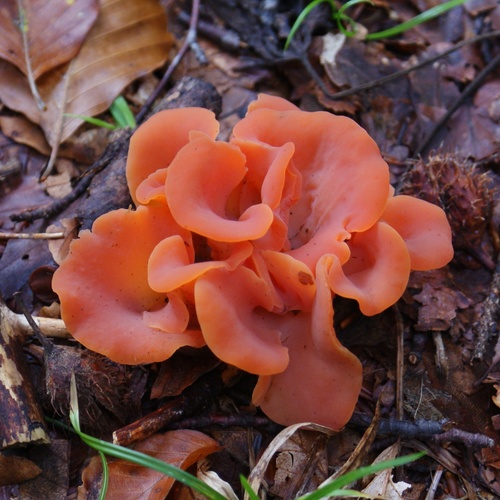
About Guepinia helvelloides (DC.) Fr.
The fruit bodies of Guepinia helvelloides grow singly or in small clumps. Though their fruit bodies appear to grow from soil, the fungus's mycelium lives in buried wood. Individual fruit bodies are 4–10 cm (1+1⁄2–4 in) tall and 1–17 cm (1⁄2–6+3⁄4 in) wide. They have a spoon or tongue shape, twisted like a cornet or horn to resemble a slender funnel, with one side open and often a wavy margin. Fruit bodies are flexible, 2–3.5 mm (1⁄16–1⁄8 in) thick, and smooth on their outer side. This outer side tapers along the underside into a cylindrical or depressed stem that grows up to 5 cm (2 in) high and around 1.5 cm (1⁄2 in) thick. The base of the stem is typically covered in a white, woolly tomentum. The upper (inner) surface of the fruit body is usually mostly sterile, with only a few isolated basidia, and is slightly warty due to densely packed protruding ends of hyphae. The sterile and fertile surfaces of the fruit body are nearly identical in color, ranging from transparent reddish-orange to flesh pink or flesh orange, and sometimes darker purplish-red. Old fruit bodies usually develop a faint brownish tinge, and the underside is typically slightly more brightly colored than the upper side. The flesh is gelatinous, soft in the upper part of the fruit body, and has a more cartilage-like texture in the stem. The fungus has an unremarkable odor, and a watery, indistinct taste. The spore-bearing hymenium develops on the lower (outer) side of the fruit body. The spore-producing basidia are made of a globular base section called the hypobasidia, to which inflated or elongated epibasidia attach. In Guepinia helvelloides, hypobasidia are egg-shaped to ellipsoid, measuring 12–16 by 9–12 μm, and attach to fibril-like epibasidia that are 20–45 by 3–4 μm. Spore deposits are white, while individual spores measure 9–11 by 5–6 μm. They are hyaline (translucent), cylindrical to elongated ellipsoid, and each contains a large oil drop. Guepinia helvelloides is saprobic, meaning it gets nutrients by breaking down organic matter. Its fruit bodies typically grow singly or in small tufts on soil, and are almost always associated with buried rotting wood. Fruit bodies can appear in spring, but are most common in summer and autumn. In North America, it grows in coniferous forests, and is found across temperate North America from Canada to Mexico. It is also found in Europe, Iran, Turkey, Brazil, Puerto Rico, and the Qinling region of China. Guepinia helvelloides is edible, but has a bland flavor. Older specimens are usually tough and indigestible. It can be eaten raw in salads, pickled in vinegar, or preserved in sugar like candied fruit. One source notes it can be used to make a wine by fermenting it with wine yeast.

