About Gryllus pennsylvanicus Burmeister, 1838
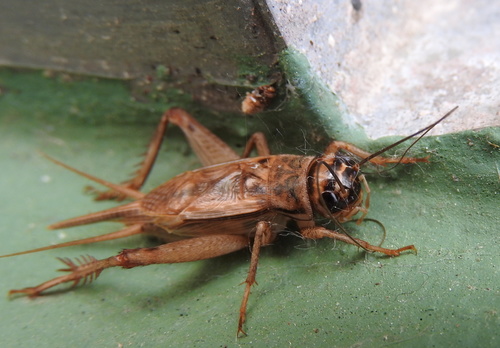
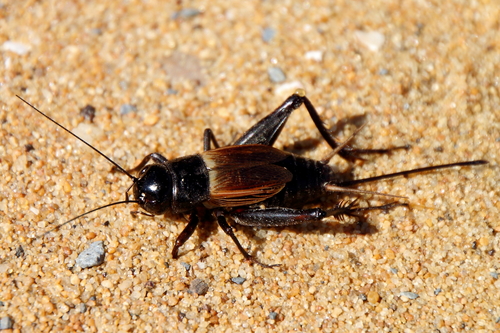
Identification: Adult Gryllus pennsylvanicus measure 15–25 millimetres (0.6–1.0 in) in length. Their color ranges from dark black to dark brown, with some specimens showing a faint reddish tint. Their black antennae are typically longer than the body length of the species. Their cerci are longer than the combined length of the head and prothorax, and the wings do not extend past the cerci. Life cycle: During the breeding season, the peak number of adult female G. pennsylvanicus captured in pitfall traps occurs approximately two weeks after the peak capture of adult males, which indicates this species exhibits protandry. In some regions, breeding coincides with the seed rain of certain agricultural weeds. This may provide females with additional food resources that increase their fecundity. Males call from the mouths of burrows or ground cracks, and retreat into these openings when disturbed. In the field, calling males are spaced between approximately 7.7 to 10.3 meters apart from one another. This spacing likely makes it energetically costly for females to sample large numbers of potential mates. The calling song of male G. pennsylvanicus is made up of short chirps, produced at a rate of roughly two to three chirps per second. Each chirp contains three to five pulses, with each pulse corresponding to a single closure of the male’s forewings (also called tegmina). Like most other gryllines, female G. pennsylvanicus are attracted to male calling song, and prefer higher calling effort at least when population density is low. In a well-designed series of field experiments, Zuk demonstrated that female G. pennsylvanicus are more attracted to the calling song of older males than that of younger males. Males found paired with females in the field were also older than unpaired calling males located nearby. However, in this experiment, higher calling effort accounted for a small but statistically significant share of the variance in female attraction. This leaves open the possibility that the observed female preference for older males’ songs could stem from differences in calling effort between older and younger males. Adults are mostly active at night, when males sing to attract females. After mating, females lay eggs by inserting their ovipositor into soil. A single female lays around 50 eggs at a time, and can lay more than 400 eggs over the course of her lifespan. Eggs laid in late summer and fall overwinter in the soil and hatch the following spring. This species produces one generation per year. As winter approaches, adults sometimes enter homes to attempt to overwinter there.