About Grus nigricollis Prjevalsky, 1876
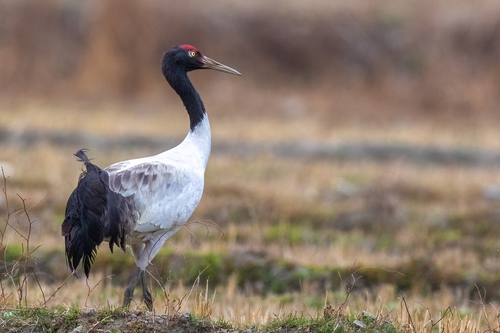
This is a medium-sized crane species, Grus nigricollis (black-necked crane), that is mostly grey, with a fully black head and neck. The lores and crown are bare and dull red, and a small patch of white feathers sits below and behind the eye. It has a black tail, which allows easy distant distinction from the similar common crane, which has a grey tail. For distribution and habitat, black-necked cranes spend the summer mainly on the high-altitude Tibetan Plateau. Their breeding habitats are alpine meadows, lakeside and riverine marshes, and river valleys, and they also use local barley and wheat fields. Their wintering grounds are typically sheltered valleys or lower elevation areas. Most of the species' global population lives in China, with smaller groups extending into Bhutan, India, and Vietnam. Small populations have been recorded in northern Sikkim; a small group of 20 to 40 regularly visited the Subansiri area in the Apa Tani valley until 1975, and vagrant individuals have been observed in Nepal. In 1991, an estimated 600 to 900 black-necked cranes lived on the Hongyuan-Ruoergai Plateau in Sichuan, China, which was the species' most important breeding and summering area at that time. A 2013 survey counted 893 total cranes in the Zoigê Marsh. In 1996, the global total population was around 4,000 individuals, most of which wintered in Tibet in the valleys of the Nyanga, Lhasa, and Pengbo rivers, as well as the middle reaches of the Yarlung Tsangpo. Hutoushan Reservoir in the Pengbo valley is an important winter resting site, and the 96-square-kilometer Linzhou Black-necked Crane Preservation Zone was established there in 1993. By 2018, the black-necked crane population in Lhünzhub County exceeded 2,100 individuals, and the largest recorded colony held 400 to 500 individuals. Small numbers of black-necked cranes also winter in two valleys of western Arunachal Pradesh, India: the Sangti Valley and the Zemithang Valley. In terms of behaviour and ecology, black-necked cranes forage on the ground in small groups, often with one individual acting as a sentinel. In winter, groups arrive at and depart from feeding grounds together, but may split into smaller family groups that each maintain their own small feeding territory within a large marsh or field. Black-necked cranes spend roughly 75% of their day foraging, with peak feeding activity in the early morning and late afternoon. While foraging, they move continuously on foot and travel long distances between feeding spots, covering several kilometers per day. Their diet includes sedge tubers, plant roots, earthworms, insects and other invertebrates, frogs, and other small vertebrates. They also eat fallen grain of barley, oats, and buckwheat, and will sometimes dig up and consume potatoes, carrots, and turnips. Their loud trumpeting calls are similar to those of other crane species. Black-necked cranes are very wary of humans, but in some areas they become accustomed to local people that do not disturb them. They appear able to distinguish people wearing traditional clothing, and are particularly wary of other people. Like many other crane species, black-necked cranes are thought to form long-lasting pair bonds, and perform dancing displays during the breeding season. Breeding individuals are territorial and will immediately chase away intruders of the same species, though they are generally tolerant of other species. Their nest site is usually a pre-existing mud island within a large shallow wetland, and is sometimes shared with bar-headed geese. Nests range from a sparsely lined scraped depression in the ground to a built structure of grass, rushes, and weeds with a central depression; occasionally eggs are laid directly on grass with no constructed nest. Egg laying occurs mostly in May and June, and clutches hold one or two eggs. Adult cranes are more wary when their chicks are small. Until the young cranes are able to fly, the family stays close to the nesting area; after that, the family travels widely across the area each day. Even though young cranes can forage independently, they usually accompany their parents during foraging. Family groups use short, subdued nasal "kurrr" calls to stay in contact; adults also use this call to let juveniles know food is available. In Ladakh, adults have been observed feeding their young mostly fish, catching fish in a heron-like fashion.