About Grus monacha Temminck, 1835
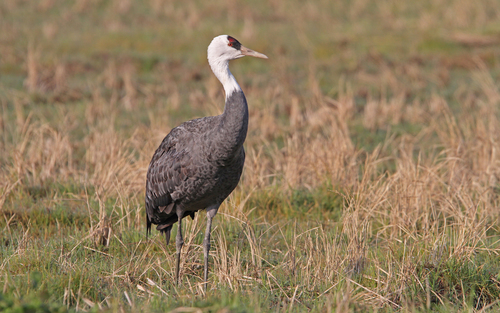
Grus monacha, the hooded crane, has a grey body. The top of its neck and head is white, with the only exception being a patch of bare red skin above the eye. It is one of the smallest crane species, though it remains a fairly large bird, measuring 1 m (3.3 ft) in length, weighing 3.7 kg (8.2 lb), and having a wingspan of 1.87 m (6.1 ft). The hooded crane breeds in south-central and south-eastern Siberia. Breeding is also suspected to take place in Mongolia. Over 80% of the total hooded crane population winters at Izumi, located in southern Japan. Additional wintering grounds for the species are found in South Korea and China. Around 100 hooded cranes winter at Chongming Dongtan, Shanghai every year. Dongtan Nature Reserve is the largest natural wintering site for the species in the world. In December 2011, a hooded crane was recorded overwintering at Hiwassee Refuge in southeastern Tennessee, which is well outside the species' normal range. In February 2012, another hooded crane was observed at Goose Pond in southern Indiana, and this individual is suspected to be the same bird that was seen in Tennessee. It has been suggested that this bird may have migrated to North America by following sandhill cranes (Antigone canadensis). In March 2020, seven hooded cranes (Grus monacha) were sighted on Siargao, Philippines. This encounter was the first recorded observation of the species in the country, and since this sighting, hooded cranes have migrated to the Philippines frequently, mainly to wetlands in the southern regions of the country.