About Grus leucogeranus Pallas, 1773
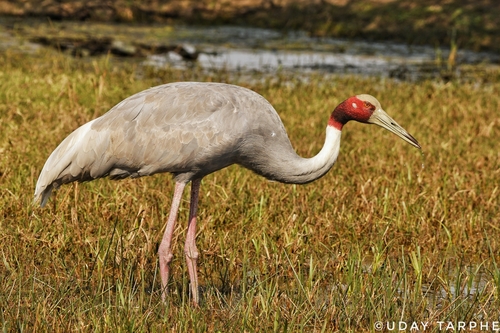
This species, the Siberian crane (Grus leucogeranus Pallas, 1773), is a fairly large crane. Adult individuals of both sexes have fully pure white plumage, with the only exceptions being black primaries, alula, and primary coverts. Their fore-crown, face, and sides of the head are bare and brick red; they have a dark bill, pinkish legs, and yellowish irises. Juveniles have feathered faces and dingy brown plumage. Unlike some other crane species, Siberian cranes do not have elongated tertial feathers. During breeding season, both males and females often have mud streaks across their feathers. It is hypothesized that they intentionally smear mud on their feathers to help camouflage their nests. Their call differs from the trumpeting call of most cranes, and is described as a goose-like high-pitched whistling 'toyoya'. On average, males are larger than females. This species typically weighs 4.9–8.6 kg (11–19 lb), stands about 140 cm (4 ft 7 in) tall, has a reported wingspan of 210 to 260 cm (6 ft 11 in to 8 ft 6 in), and a body length of 115–127 cm (45–50 in). One study recorded an average adult weight of 6.81 kg (15.0 lb), while juveniles had a slightly higher average weight of 7.1 kg (16 lb). There is a single recorded observation of an exceptionally large male that weighed 15 kg (33 lb). This species is usually slightly smaller in weight and height than some other cranes, most notably the sarus crane, wattled crane, and red-crowned crane. Historically, the breeding range of the Siberian crane stretched from between the Urals and Ob River, south to the Ishim and Tobol rivers, and east to the Kolyma region. Populations declined due to land use changes, wetland drainage for agricultural expansion, and hunting along migration routes. In modern times, breeding areas are restricted to two widely separated regions: the western region in the river basins of the Ob, Konda, and Sossva, and a much larger eastern population in Yakutia between the Yana and Alazeya rivers. Like most cranes, the Siberian crane lives in shallow marshlands and wetlands, and often forages in deeper water than other cranes. They have very high site fidelity for both wintering and breeding areas, returning to the same sites year after year. The western population winters in Iran; some individuals of this population formerly wintered in India, as far south as Nagpur and as far east as Bihar. Eastern populations winter mainly in the Poyang Lake area in China. Siberian cranes are widely dispersed across their breeding areas and are highly territorial. They maintain feeding territories during winter, but may form small, loose flocks, and gather more closely at winter roosts. They are strongly diurnal, feeding almost throughout the entire day. When feeding on submerged vegetation, they often submerge their entire heads underwater. When calling, they stretch their necks forward. Several call contexts have been identified, and many of these calls differ between sexes. Individual call variation is very slight, and most calls have a dominant frequency of about 1.4 kHz. Unison calls, which are duets between paired males and females, are more distinctive, with clear differences between pairs. The female produces a higher-pitched call that makes up the 'loo' component of the duetted 'doodle-loo' call. To protect their territory, pairs will walk around other pairs to threaten them and drive them away from the area. In captivity, one individual was recorded to live for nearly 62 years, while another lived for 83 years.