About Grus antigone (Linnaeus, 1758)
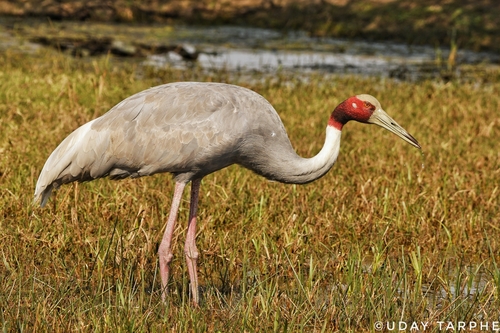
Grus antigone, the sarus crane, was formally described by Linnaeus in 1758. Adult sarus cranes are very large, with grey wings and body, a bare red head, collar and nape, a greyish crown, and a long, pointed greenish-grey bill. In flight, the long neck is held straight (unlike the folded neck of a heron), black wing tips are visible, and the long pink legs trail behind the body. Adults also have a grey ear covert patch, orange-red irises, and a greenish-grey bill. Juveniles have a yellowish base to the bill and a fully feathered brown-grey head. The bare red skin on the adult's head and neck becomes brighter during the breeding season; this skin is rough, covered by feather follicles, with a narrow area around and behind the head covered in black, bristly feathers. Sexes do not differ in plumage, though males are on average larger than females. Males from the Indian population can reach a maximum height of around 180 cm (5.9 ft), making the sarus crane the world's tallest extant flying bird. Individuals of the nominate race weigh 6.8–7.8 kg (15–17 lb), while five adult A. a. sharpii averaged 8.4 kg (19 lb). Across the species' entire range, weight varies from 5 to 12 kg (11 to 26 lb), typical height ranges from 115 to 167 cm (45 to 66 in), and wingspan ranges from 220 to 250 cm (87 to 98 in). Individuals from northern populations are among the heaviest cranes, alongside the red-crowned and wattled cranes, and the largest in their range, while birds from Australia tend to be smaller. In Australia, sarus cranes can easily be mistaken for the more widespread brolga; brolgas have red colouring confined to the head, which does not extend onto the neck. Average body mass of Australian sarus cranes is 6.68 kg (14.7 lb) for males and 5.25 kg (11.6 lb) for females, with a total range of 5.0 to 6.9 kg (11.0 to 15.2 lb) for both sexes. Australian sarus cranes are on average about 25% lighter than their northern counterparts, and marginally lighter on average than brolgas.
Historically, the species was widely distributed across lowlands of India along the Gangetic plains, extending south to the Godavari River, west to coastal Gujarat and Tharparkar District, Pakistan, and east to West Bengal and Assam. Sarus cranes no longer breed in Punjab, but they winter there regularly. They are rare in West Bengal and Assam, and are no longer found in Bihar. In Nepal, their distribution is restricted to western and central lowland plains, with most of the population occurring in Rupandehi, Kapilvastu, and Nawalparasi districts. Three distinct sarus crane populations were historically recognized in Southeast Asia: the northern population in China and Myanmar, the southern population in Cambodia and Vietnam, and the distinct, likely-extinct luzonica subspecies once found in the Philippines. The species once ranged into Thailand and further east to the Philippines, but is now likely extinct in both. In 2011, 24 captive-bred cranes descended from five founders were reintroduced to Thailand. A reasonably sized population of over 150 breeding pairs has been discovered in Myanmar's Ayeyarwadi delta, with additional cranes confirmed in Kachin, Shan, and Rakhine states. In Australia, the species is found only in the northeast, and is partly migratory in some areas. The species' global range has shrunk, and India holds both the largest occupied area and the largest known population. Expansion of paddy fields and irrigation canal networks during and before the Green Revolution may have helped increase sarus crane distribution and numbers in India by providing more reliable moisture levels across many locations. Although the species is now found mainly in low elevation plains, historical records exist from highland marshes further north in Harkit Sar and Kahag in Kashmir. Sarus cranes breed in some high elevation regions such as near Pong Dam in Himachal Pradesh, where populations may be growing due to increasing rice cultivation along the reservoir. In rice-dominated districts of Uttar Pradesh, sarus crane occupancy (a measure of abundance) was highest in western districts, intermediate in central districts, and minimal in eastern districts. Sarus crane abundance was positively associated with the percentage of wetlands on the landscape, and negatively associated with the percentage of area under rice cultivation.
The distinct Philippine subspecies, luzonica, was first incorrectly classified as subspecies sharpii when it was first described to science in 1895. It has been known to locals for centuries as tipol (alternatively tipul or tibol) in local languages. Around 1590–1610, Mentrida recorded a bird in Iloilo that some believe to be the sarus crane. In 1668, Francisco Ignacio Alcina noted a bird larger than Spanish cranes in eastern Visayas, particularly Samar, which locals called tihol. According to Alcina, the bird "was about a yard (vara) and a half tall... the color is light brown or dark ashy... It has a red head up to a good portion of its neck..." In 1702, Kameli also recorded a bird called tipul in Samar. Regardless of whether the Visayan bird mentioned was the same as the Luzon-based sarus crane, the first known actual depiction of the Philippine sarus crane was produced in 1847, when Filipino painter Jose Honorato Lozano (ca. 1815–1885) created the work "Indio Vestido de Anajao" (Filipino Wearing an Anahao Dress), which depicts a Filipino at the center surrounded by two Philippine sarus cranes in Manila. In 1878, Mirasol published a paper about a crane sighting in Iloilo that some believe depicts the sarus crane. The Philippine sarus crane was a common resident of Luzon until the 20th century. In 1909, American ornithologist Richard McGregor recorded that the subspecies was abundant in areas around Cabanatuan in Nueva Ecija, as well as at Candaba Swamp. In 1906, zoologist Dean Conant Worcester recorded the subspecies' abundance in Cagayan and Isabela in northern Luzon. Worcester noted that the birds nest on the ground in May; by August, after the birds lose their long wing feathers and can only rise a few feet from the ground, hunters pursued them on horseback with lassos. When running on the ground, the birds were said to "run about as fast as deer". Japanese zoologist Masauji Hachisuka formally described the Philippine sarus crane from Luzon as the separate endemic subspecies luzonica in 1941. According to Jean Delacour and Ernst Mayr, the luzonica subspecies, which they called the "Eastern Sarus Crane", was a resident subspecies in central and northern Luzon that bred in the province of Nueva Ecija. In 1971, John Dupont noted that the subspecies occurred in "northern and central Luzon". The subspecies is generally believed to have been decimated by destructive environmental policies during the Marcos dictatorship, which caused massive loss of sarus crane habitat via expansive land conversion that benefitted Marcos cronies, alongside severe poaching driven by extreme poverty and other environmental and social issues of the era. By 1991, Edward Dickinson classified the subspecies as "probably extirpated". In 2000, Robert Kennedy classified the bird as "rare, perhaps extirpated." In 2016, the WBCP Checklist classified the subspecies as extirpated. In 2020, DNA analyses found that a single sample from a Luzon sarus crane was more genetically related to the Australian subspecies (A. a. gillae) than the geographically closer Indochinese subspecies (A. a. sharpii). This study debunked earlier claims that luzonica sarus cranes were the same as sharpii sarus cranes, and strengthened the scientific consensus that luzonica is a distinct subspecies. The study also suggests that Australia, rather than mainland Asia, may be a more appropriate source of birds for reintroducing sarus cranes to the Philippines. In June 2025, the Association of Systematic Biologists of the Philippines (ASBP) convened a national symposium in Manila bringing together researchers from The Cairns Institute (TCI) and the University of the Philippines Los Baños (UPLB) to plan sarus crane reintroduction in the Philippines. Based on recent genetic analysis, researchers concluded that the best genetic fit for reintroduction comes from Queensland, though the Southeast Asian subspecies (G. a. sharpii) remains a potential alternative. Final confirmation will require future analysis of more tipol specimens. Researchers also inspected tipol specimens preserved at the University of Santo Tomás (UST) museum and the National Museum of Natural History (NMNH) in Manila. To improve certainty around the genetic relationships of tipol, as many specimens as possible are scheduled to be tested for their genetic affinities to both Australian and Southeast Asian sarus cranes. Three potential reintroduction sites were discussed, one of which is Lalaguna Marshland near the municipality of Lopez in Quezon province. The Lopez municipal council has expressed enthusiasm for potential reintroduction at Lalaguna, one of the last places where tipol were observed before extirpation. The symposium also established a step-by-step approach for the reintroduction effort: (i) confirmation of the appropriate source of birds for reintroduction; (ii) community engagement around potential reintroduction sites and nationally; (iii) preliminary discussions with Philippine and source country authorities and NGOs; (iv) selection of a preferred reintroduction site; (v) preparation and submission of a comprehensive costed project plan; (vi) project approval; (vii) fundraising and ongoing engagement for the reintroduction; (viii) acquisition and translocation of eggs or birds to a specialized purpose-built rearing facility in the Philippines; (ix) rearing and preparation for release under strict biosecure conditions; (x) release and monitoring over a three to four year period, until a sustainable wild population can be established.
Field surveys and detailed observations of sarus cranes in Myanmar increased greatly by 2022, with a strong focus on the Ayeyarwadi delta. Surveys across multiple townships discovered over 150 breeding pairs of sarus cranes (with a maximum of 185 nests monitored in 2018), indicating the population in this region is far larger than previously known. The vast majority of nests were located in rice paddies, with a small number in flooded grass patches. Until recently, little was known about sarus crane ecology in Australia. Breeding records (confirmed sightings of nests with eggs, or of adult birds with flightless young) were only known from three locations, all in the Gulf Plains in Queensland. Two records are from near Normanton: one of adults with flightless chicks seen about 30 km west of the town, and another of adults incubating eggs seen 7 km south of the town. The third record comes from a one-month study that details 32 nests located within 10 km of Morr Morr cattle station in the Gilbert River floodplains. A 3,000-km survey along the Gulf of Carpentaria located 141 territorial breeding pairs spread across the floodplains of the Mitchell, Gilbert, and Flinders Rivers. Careful mapping of sarus crane breeding areas in Australia is needed to fully understand their distribution range. The species is uncommon in Kakadu National Park, where it is often hard to distinguish among the more numerous brolgas. Non-breeding season flocks are commonly seen in the Atherton Tablelands in northeastern Queensland.
In India, sarus cranes preferentially use wetlands for nesting, but will also nest in uncultivated patches amid flooded rice paddies (called khet-taavadi in Gujarat), and will nest in rice paddies especially when wetlands are not available to breeding pairs. Breeding pairs are territorial and prefer to forage in natural wetlands, though they also frequent wetland crops such as rice and wheat. In south-western Uttar Pradesh, sarus cranes are found in wetlands of all sizes, with larger numbers in larger wetlands. In Australia, wintering nonbreeding sarus cranes forage in areas with intensive agriculture (primarily maize, sugarcane, groundnuts) and smaller cattle-grazing patches in the Atherton Tablelands. They have been observed feeding on grain, nuts, and insects from a range of crop fields, including stubble from maize and peanut crops, hay crops, fields with potatoes, legumes, and seed crops, and post-harvest fields of sugarcane, grass, and fodder crops. Territorial breeding sarus crane pairs in northern Queensland along the Gulf of Carpentaria use a range of habitats, but preferentially use low, open woodland on quaternary alluvial plains in outer river deltas and levees with vegetation including Lysiphyllum cunninghamii, Eucalyptus microtheca, Corymbia confertiflora, Melaleuca spp., Excoecaria parvifolia, Atalaya hemiglauca, Grevillea striata, Eucalyptus leptophleba, C. polycarpa, C. confertiflora, and C. bella.
Unlike many other crane species that make long migrations, sarus cranes are largely nonmigratory, though some populations make short migrations. Four distinct population-level movement behaviours have been noted in South Asia. The first is the small "wintering population" that uses wetlands in Punjab during winters; the source of this population is unclear, but it is very likely from the growing population in Himachal Pradesh. The second is the "expanding population" of cranes that appear in new areas after new irrigation structures are built in semiarid and arid areas, primarily in Gujarat and Rajasthan. The third is the "seasonally migratory" population, also primarily in the arid zone of Gujarat and Rajasthan. Cranes from this population aggregate in remaining wetlands and reservoirs during the dry summer, and breeding pairs establish territories during the rainy season (July – October), remaining on territories throughout winter (November – March). The fourth group is the "perennially resident" population found in areas such as southwestern Uttar Pradesh, where artificial and natural water sources allow cranes to stay in the same location year-round. Migratory populations also exist in Southeast Asia and Australia.
Breeding pairs maintain territories that they defend from other cranes using a large repertoire of calls and displays. In Uttar Pradesh, less than a tenth of breeding pairs maintain territories at wetlands; the rest are scattered across smaller wetlands and agricultural fields. Non-breeding birds form flocks ranging from 1 to 430 birds. In semi-arid areas, breeding pairs and successfully fledged juveniles leave territories in the dry season to join non-breeding flocks. In areas with perennial water supply, such as the western plains of Uttar Pradesh, breeding pairs maintain perennial territories. The largest known flocks are from the 29 km2 (11 mi2) Keoladeo National Park, with as many as 430 birds, and from unprotected community-owned wetlands in Etawah and Mainpuri districts in Uttar Pradesh, ranging from 245 to 412 birds. Flocks of over 100 birds are also reported from Gujarat in India and Australia. Sarus crane populations in Keoladeo National Park have been observed to drop from over 400 birds in summer to just 20 birds during the monsoon. In areas with perennial wetlands on the landscape, such as western Uttar Pradesh, numbers of nonbreeding sarus cranes in flocks can be relatively stable throughout the year. In Etawah and Mainpuri districts, nonbreeding sarus cranes make up up to 65% of the regional population. Breeding pairs in Australia similarly defend territories from neighboring crane pairs, and nonbreeding birds are found in flocks frequently mixed with brolgas.
The most common social units for sarus cranes are breeding pairs that defend territories within which they raise young, and non-breeding cranes that live in flocks. Paired birds can be recognized by their behaviour of producing unison calls, or duets, used either at territory borders toward neighboring pairs, on the nest when adults switch incubation duties, or in response to intrusions of other sarus cranes into or over their territories. Rarely, sarus crane pairs allow a third crane into their territory to form trios that produce synchronized unison calls called "triets". Sarus crane trios are rare (1.6% of 11,591 observed groups) but occur across their range, can be both polyandrous and polygynous, improve breeding success, are seen more often in areas with more non-breeding flocks, and form largely in areas with poor quality habitat and territories. Triets are structurally distinct from duets, having much lower frequencies and being longer, but the functional significance of this difference is unknown. One observed polyandrous trio had a young male as the third bird (identified by primary feather coloration), which suggests breeding pairs may allow younger birds into their territories to help raise chicks as part of trios. For breeding pairs, the advantage of being in a trio is clearly improved breeding success, and potentially additional assistance defending territories. However, the advantage for third birds is not yet known, and it is suspected that trios provide younger cranes practice raising chicks and defending territories. Social units of cranes are very poorly studied, and it is considered unlikely that trios are unique to sarus cranes.
Sarus cranes roost in shallow water, where they may be safe from some ground predators. Adult birds do not moult their feathers annually; instead, feathers are replaced about once every two to three years.