About Grus americana (Linnaeus, 1758)
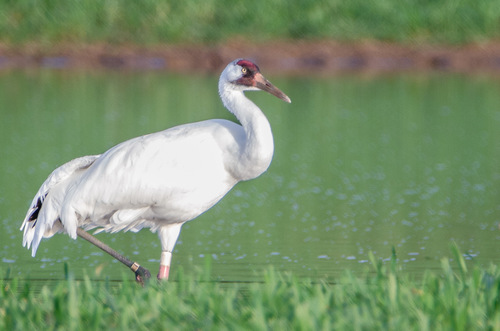
Adult whooping cranes (Grus americana) have white plumage, a red crown, and a long, dark, pointed bill. Immature whooping cranes are cinnamon brown. When in flight, whooping cranes hold their long necks straight, and their long dark legs trail behind; adult birds have visible black wing tips during flight. Historically, the whooping crane’s range stretched across midwestern North America and extended south into Mexico. By the mid-20th century, the only remaining remnant of the species’ former nesting habitat was the muskeg of the taiga in and around Wood Buffalo National Park, located in Alberta and the Northwest Territories, Canada, which forms the Whooping Crane Summer Range. The recent Whooping Crane Eastern Partnership Reintroduction Project allowed whooping cranes to nest naturally for the first time in 100 years at Necedah National Wildlife Refuge in central Wisconsin, United States. This reintroduced population has since expanded its summer range into Wisconsin and surrounding U.S. states. Additional experimental non-migratory reintroduced populations have been established that nest in Florida and Louisiana. The Florida reintroduction has been halted and is considered a failure, due to high adult mortality, low juvenile recruitment, and high rates of habitat loss. Whooping cranes nest on the ground, most often on a raised patch of land within a marsh. Females lay 1 or 2 eggs, typically between late April and mid-May. The eggs are blotchy and olive-coloured, averaging 2.5 inches (60 mm) in breadth, 4 inches (100 mm) in length, and approximately 6.7 ounces (190 g) in weight. Incubation lasts 29 to 31 days. Both parents brood young chicks, though the female is more likely to directly care for the young. Usually, no more than one young chick survives per breeding season. Parents typically feed their young for 6 to 8 months after hatching, and the parent-offspring relationship ends after approximately one year. Breeding whooping crane populations winter along the Gulf coast of Texas, United States. Their winter range includes areas near Rockport at Aransas National Wildlife Refuge, as well as Sunset Lake in Portland, Matagorda Island, Isla San Jose, and portions of the Lamar Peninsula and Welder Point on the east side of San Antonio Bay. Salt Plains National Wildlife Refuge in Oklahoma is a major migratory stopover for the species, hosting 60 to 75 percent of the entire whooping crane population each year. During the 2011/2012 winter season, up to nine whooping cranes were observed at different times on Granger Lake in Central Texas. Drought conditions in 2011 exposed large portions of the lake bed, creating abundant feeding grounds for the cranes as they passed through Texas on their autumn migration.