About Grimmia laevigata (Brid.) Brid.
Gametophyte Sexual System
Gametophyte: It is dioicous.
Female Perichaetial Leaf Morphology
For the female, the innermost perichaetial leaf is up to 2 mm long. It sheaths up to the broadest part of the leaf, is narrowed at the leaf base, and is ovate to broad - ovate. The lower half is hyaline or has only some rows of hyaline cells at the margin, which vanish at the mid - leaf.
Female Perichaetial Leaf Costa
The costa is obscure in the apical part and excurrent in a long, denticulate hair - point.
Male Perigonia Structure
The perigonia are multifoliose buds at the tips of branches.
Male Perigonial Leaf Morphology
For the male, the innermost perigonial leaf is up to 1 mm long, sheathing, broad - ovate, and suddenly narrowed to an acute apex with a hyaline cell. It is hyaline in the lower part, and the costa vanishes below the apex.
Male Paraphyses
The paraphyses are short and numerous.
Gametophyte Growth Form
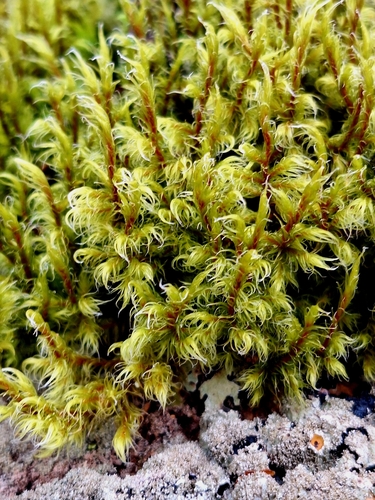
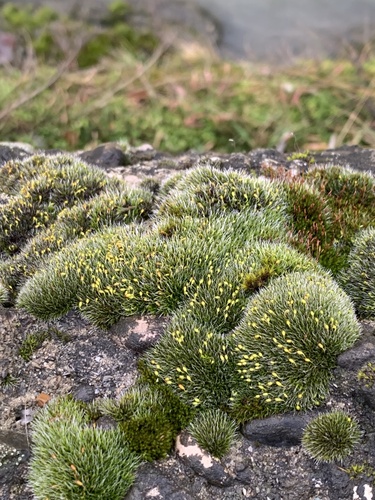
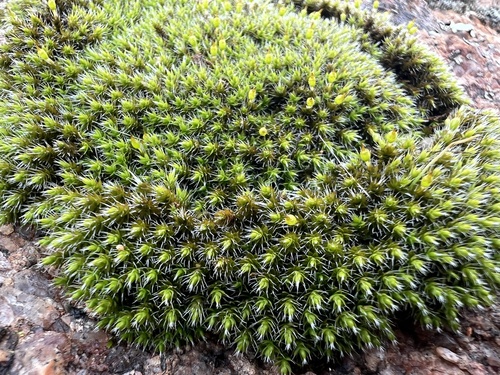
The growth form has a lax cushion. Young shoots are mostly present, originating from decomposing plants, with scale - like leaflets appressed to the stem.
Young Shoot Leaf Costa
The costa vanishes below the acute apex, with a sharply pointed hyaline cell or short hair - point.
Gametophyte Stem Morphology
The plants are erect, scarcely branched, slightly radiculose at the base, and the stems are up to 20 mm high with a well - developed central strand.
Stem Leaf Size Gradient
The leaves in the lower part of the stem are scale - like, gradually getting longer towards the tip of the stem, 1.2 - 1.8 mm long, rarely up to 3 mm long.
Dry Leaf Posture
They are imbricate, appressed to the stem when dry.
Moist Leaf Posture
Older leaves bend backwards when moistened, and younger leaves move slightly, being erect or spreading when wet.
Leaf Base and General Shape
They start from a short (about 1/5 of leaf length), rounded, half - sheathing, slightly decurrent leaf base, are lingulate or broad - lanceolate, and taper to an obtuse, rounded, or even acute apex.
Leaf Hair-Point
The hair - point is roughly denticulate, occasionally nearly smooth.
Leaf Concavity and Margin
The leaf form in situ is widely concave or concave throughout, and the margin is plane.
Basal Paracostal Cells
Some rows of basal paracostal cells are rectangular with smooth or faintly nodulose walls.
Sheathing Part Marginal Cells
Towards the margin in the sheathing part, the cells are isodiametric, transversely rectangular, or oval, with transverse walls thicker than longitudinal walls.
Laminal Cells
In the laminal part, the cells are homogeneous, rounded, and have thick walls.
Leaf Stratification
The leaf base, in transverse section, is unistratose, bistratose in places in the transitional part, and bi - to tristratose in the laminal part.
Marginal Stratification
At the margin from the insertion up to the apical part, one or more cell rows are unistratose, at least one side is unistratose in the apical part, and it is bistratose at the apex.
Costa Surface Morphology
The costa, seen on the dorsal side, is large at the leaf base, indistinct from above the widest part of the leaf up to the apex, and excurrent. In the laminal part, the dorsal cells are not different from the lamina cells.
Costa Transverse Section Shape
In transverse section, on the dorsal side at the insertion and lower part of the leaf, it is flat or weakly convex, and slightly rounded in the upper part. On the ventral side, it is widely channelled at the leaf base and narrowly so in the upper part.
Costa Base Internal Structure
At the insertion and leaf base, there are 7 to 11 ventral cells, most of which are guide cells, with a small median band of substereids interrupted by 3 groups or one large central group of hydroids.
Costa Apical Internal Structure
The substereids and hydroids vanish in the apical part. In the transitional part, the number of guide - cells is reduced to 4, and in the laminal part, there are 2 guide cells sunken into a narrow channel with strongly thickened adaxial cell walls.
Sporophyte Seta and Vaginula
Sporophyte: The seta is up to 3 mm long and straight, and the vaginula is 1 mm long and cylindrical.
Sporophyte Capsule General Morphology
The capsule is emergent, obloid, and smooth.
Exothecial Cells
The exothecial cells are elongated, of variable shape, slightly curvilinear.
Stomata and Annulus
The stomata are in the short neck, and the annulus consists of three rows of cells that detach spirally in groups.
Calyptra Morphology
The calyptra is mitrate, brownish in the upper part, lobed, and covers the upper part of the capsule.
Operculum Morphology
The operculum is conical, with a straight, blunt beak, an uneven or crenulate margin, one or two marginal rows of rounded cells, and irregular, thick - walled, curvilinear, faintly nodulose cells in the conical part.
Peristome Teeth General Structure
The peristome teeth are erect when dry, broad at the base, slit half - way down to two or three branches or perforate.
Peristome Teeth Surface Ornamentation
The lower dorsal side is smooth, and the upper dorsal and ventral sides are sparingly to densely covered with rounded papillae.
Peristome Trabeculae
The trabeculae are broad, distant, protruding, and thin in the upper third.
Sporophyte Maturation Period
It matures in September.
Spore Morphology
The spores are 12 - 16 µm and smooth.