About Grevillea wickhamii Meisn.
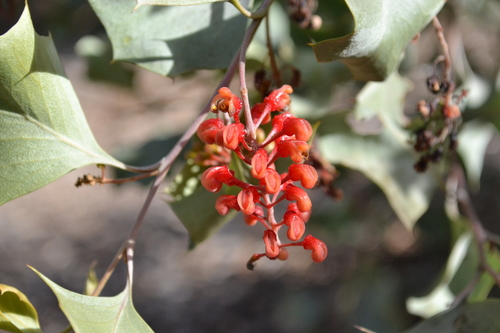
Grevillea wickhamii is an erect shrub or spindly tree that usually reaches 1 to 6 metres (3 feet 3 inches to 19 feet 8 inches) in height, and has smooth bark. Its leaves resemble holly leaves, are broadly egg-shaped overall, and measure 30 to 90 millimetres (1.2 to 3.5 inches) long by 25 to 55 millimetres (0.98 to 2.17 inches) wide, with 2 to 7 shallow pointed teeth near the leaf tip. Flowers are arranged in down-curved, sometimes branched clusters that grow in leaf axils or directly on stems. The end groups of these clusters form on a rachis that is typically 10 to 70 millimetres (0.39 to 2.76 inches) long, and each individual flower sits on a pedicel that is usually 2 to 6 millimetres (0.079 to 0.236 inches) long. Flower colour and flowering period differ between subspecies, and the pistil of the flower measures 5 to 10 millimetres (0.20 to 0.39 inches) long. The fruit is an oblong, hairless follicle 10 to 20 millimetres (0.39 to 0.79 inches) long.
Wickham's grevillea has a widespread distribution across northern Western Australia, inland regions of the Northern Territory, and western Queensland. The subspecies G. wickhamii aprica grows in open woodland or spinifex communities, found mainly south of the Kimberley region, in the Northern Territory south of Larrimah, and in a small number of locations in western Queensland. Subspecies G. wickhamii cratista is only recorded from the Bungle Bungle Range, where it grows in rocky locations within grassy woodland. Subspecies G. wickhamii hispidula grows in open woodland and spinifex communities, often near drainage lines, and occurs in the Hamersley Range and Pilbara areas, extending east to Kumpupintil Lake and Windy Corner in the Dampierland, Gibson Desert, Great Sandy Desert, Little Sandy Desert and Pilbara bioregions of northern Western Australia. Subspecies G. wickhamii macrodonta grows in low open woodland and shrubland on low hills and rocky sites in north-western Western Australia, found in near-coastal areas between Broome and Goldsworthy, and east to Derby, in the Central Kimberley, Dampierland, Great Sandy Desert and Pilbara bioregions. Subspecies G. wickhamii pallida is only known from areas near the tidal limit of the Prince Regent River, where it grows in woodland near creeks. Subspecies G. wickhamii wickhamii grows in open shrubland on sandstone and quartzite outcrops, and along the edges of plateaux in the Central Kimberley, Dampierland, Great Sandy Desert, and Northern Kimberley bioregions of northern Western Australia.