About Grevillea striata R.Br.
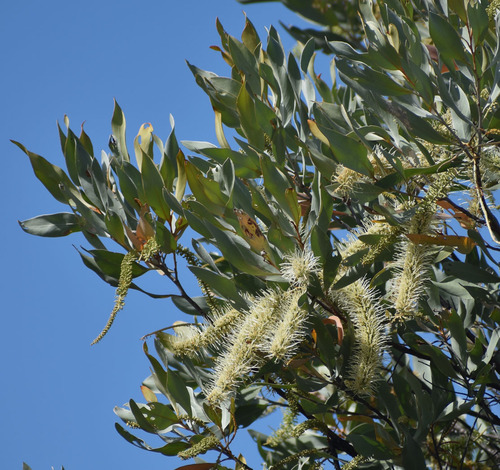
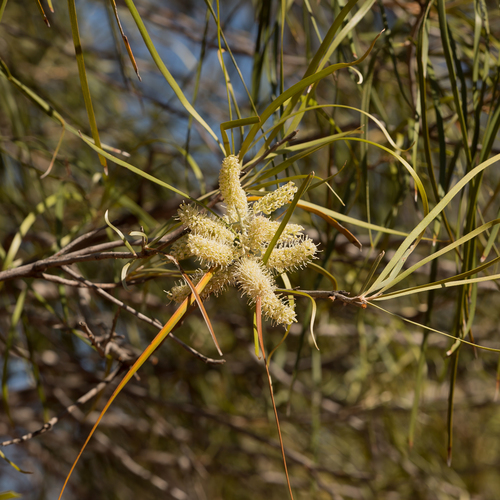
Grevillea striata, commonly known as beefwood, is an erect, spindly shrub or robust tree with dark, fissured bark. It typically reaches a height of 3 to 15 metres (9.8 to 49.2 feet), with a trunk up to 60 centimetres (24 inches) in diameter. Its leaves are linear or strap-shaped, often wavy, measuring 100 to 450 millimetres (3.9 to 17.7 inches) long and 2 to 15 millimetres (0.079 to 0.591 inches) wide. The lower surface of the leaves has between 5 and 13 prominent striations. The flowers form in clusters with up to 12 branches; each branch is cylindrical and 50 to 140 millimetres (2.0 to 5.5 inches) long. Flower color ranges from white to cream or pale yellow, and the pistil is 6 to 10 millimetres (0.24 to 0.39 inches) long. Flowering occurs mainly from August to December, and the fruit is an almost smooth, oblong to oval follicle that is 13 to 21 millimetres (0.51 to 0.83 inches) long. Beefwood grows in woodland, shrubland and spinifex communities across a range of soil types, and occurs in all mainland Australian states except Victoria. Some specimens of this species are long-lived. One mature tree, which already existed when an inscription was carved in 1845, still stands today. The inscription marks the burial of James Poole, a member of Charles Sturt's 1845 expedition who died of scurvy. Poole was buried near this beefwood tree at Preservation Creek near Milparinka, and the inscription "JP 1845" was carved into the tree. Aboriginal people, Indigenous to Australia, used resin from this tree to stick flints to their cutting tools. They also reportedly used charcoal from the tree to treat wounds and promote healing.