About Grevillea robusta A.Cunn. ex R.Br.
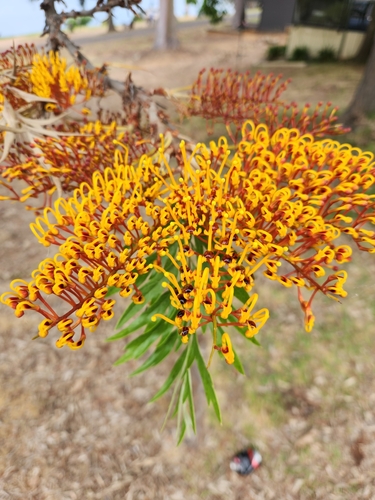
Grevillea robusta A.Cunn. ex R.Br. is a fast-growing evergreen tree with a single main trunk, reaching 5–40 m (20–100 ft) in height. Its bark is dark grey and furrowed. The leaves are fern-like, 10–34 cm (4–10 in) long, 9–15 cm (4–6 in) wide, divided into 11 to 31 main lobes. Each lobe may sometimes be further divided into up to four segments, each linear to narrow triangular in shape. The tree sheds many of its leaves just before flowering. Flowers are arranged in one-sided, toothbrush-shaped clusters, which are sometimes branched, and measure 12–15 cm (5–6 in) long. The female carpel of each flower has a stalk 21–28 mm (0.8–1 in) long. Flowers are hairless, mostly yellowish orange, and sometimes reddish. Flowering takes place from September to November, and the fruit that develops after flowering is a hairless follicle. Silky oak, the common name of this species, grows naturally in coastal areas and mountain ranges of southern Queensland and New South Wales, Australia, reaching as far south as Coffs Harbour. It grows in subtropical rainforest, dry rainforest, and wet forests. While it is now relatively rare in its natural native habitat, it has been widely planted. It has become naturalised in many locations, including Norfolk Island, Lord Howe Island, and the Atherton Tableland in Australia, and overseas in South Africa, New Zealand, Hawaii, French Polynesia, Jamaica, and Florida. It is considered a weed in parts of New South Wales and Victoria, and an invasive species in Hawaii and South Africa. The flowers and fruit of Grevillea robusta contain toxic hydrogen cyanide. A compound called tridecylresorcinol in this species causes contact dermatitis. Before aluminium became widely available, Grevillea robusta timber was widely used for external window joinery, because it is resistant to wood rot. It has also been used to make furniture, cabinetry, and fences. Due to declining populations of Grevillea robusta, felling of the tree has been restricted. The flowers produce abundant nectar, which Indigenous Australians traditionally consumed either directly from the blossom, or by shaking the nectar into water. When young, Grevillea robusta can be grown as a houseplant, and tolerates light shade, but it prefers full sun and grows best in warm regions. If planted outdoors, young trees need protection on frosty nights. Once established, the tree is hardier and tolerates temperatures as low as −8 °C (18 °F). It needs occasional watering but is otherwise fairly drought-resistant. Care must be taken when planting this species near bushland, because it can be invasive. G. robusta is often used as rootstock for grafting grevillea species that are difficult to grow from seed. It has been planted widely throughout the city of Kunming in south-western China, forming shady avenues. It is grown in plantations in South Africa, and can also be grown alongside maize in agroforestry systems. In the United Kingdom, G. robusta has been awarded the Royal Horticultural Society's Award of Garden Merit.