About Grevillea pterosperma F.Muell.
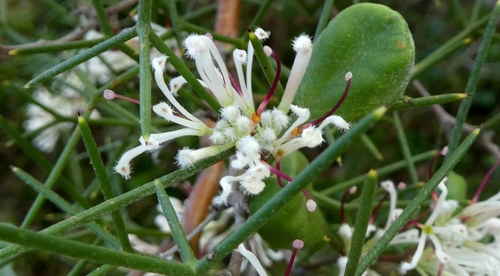
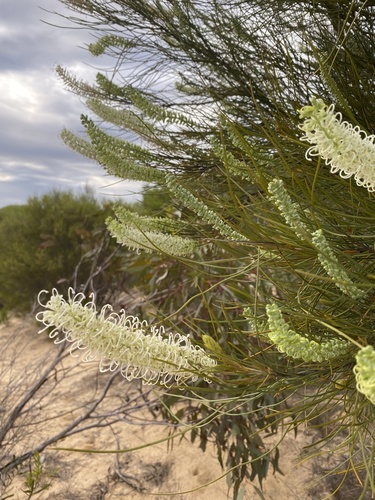
Grevillea pterosperma F.Muell., commonly known as desert grevillea, is an erect, rounded shrub that typically reaches a height of 1.5 to 4 metres (4 feet 11 inches to 13 feet 1 inch). Its leaves point upwards, are more or less linear in shape, and measure 60 to 180 millimetres (2.4 to 7.1 inches) long by 0.8 to 2 millimetres (0.031 to 0.079 inches) wide. Some leaves are divided, with up to 6 linear lobes that are 1.0 to 1.5 millimetres (0.039 to 0.059 inches) wide. The upper leaf surface has 3 to 5 longitudinal grooves, and the leaf edges are rolled under, completely hiding the lower leaf surface. The flowers are arranged in dense, cylindrical clusters 50 to 160 millimetres (2.0 to 6.3 inches) long, with flowers at the end of each cluster usually opening first. The outer surface of the flowers is greyish white, with a woolly to silky hairy texture, while the inner surface is creamy-white and more or less hairless. The style is cream-coloured to pale yellow, and the entire pistil measures 12 to 21 millimetres (0.47 to 0.83 inches) long. Flowering occurs between June and January, and the fruit produced is a hairy follicle 15 to 20 millimetres (0.59 to 0.79 inches) long. This species grows on and between sand dunes, on sandplains, and in shrublands, woodlands, and mallee habitats. It occurs mainly in inland areas of the Northern Territory, and in all mainland Australian states except Queensland.