About Grevillea mucronulata R.Br.
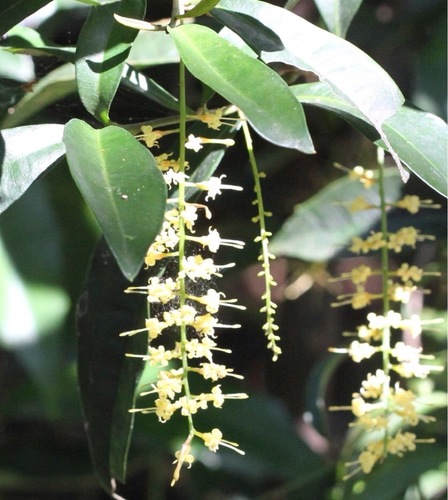
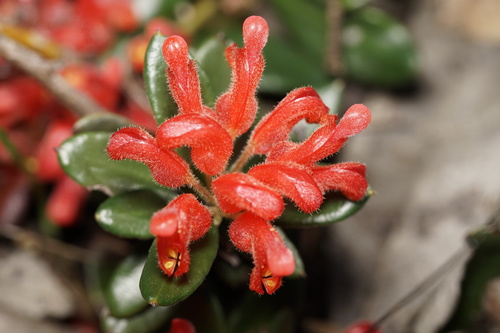
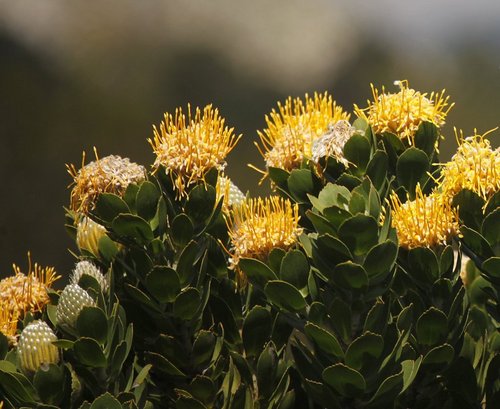
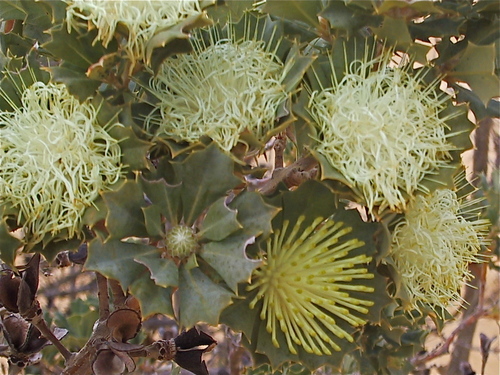
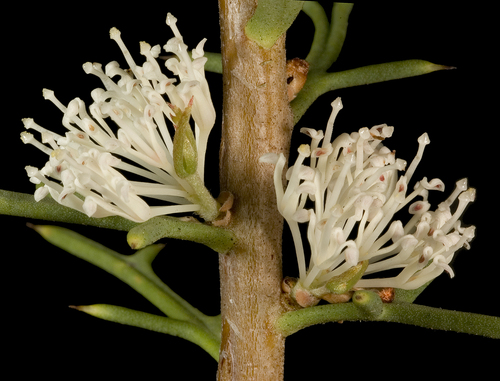
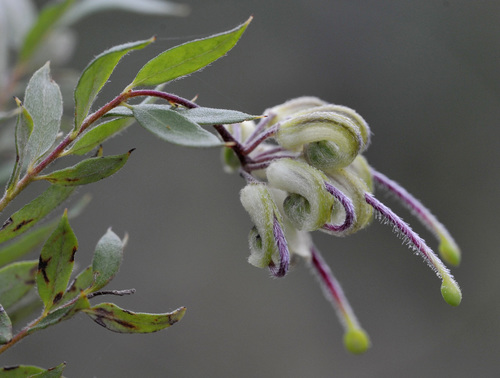
Grevillea mucronulata R.Br. is a spreading to erect shrub that typically grows 0.3 to 3 metres (1–10 ft) tall. Its leaves vary widely in shape, ranging from narrow elliptic to nearly round, and measure 0.5 to 4 cm (0.2–1.5 in) long by 0.2 to 1.8 cm (0.1–0.7 in) wide. Its green clustered flower heads, called inflorescences, bloom mostly from late autumn to mid spring, which falls between May and October in Australia. Each inflorescence holds 6 to 18 individual flowers and is 2.5–5.5 cm (1–2.3 in) long overall, and produces large quantities of nectar. The 0.8–1.7 cm long perianth is pale or yellow-green and covered in fine hairs, while the 1.8–2.8 cm long style is red or maroon, tipped with a green pollen-presenter. Several distinct forms of this species have been described, but none have been granted formal taxonomic status or rank, and further review of this species complex is needed. The 'typical form' occurs from the Lower Blue Mountains north to Singleton; it is a single-stemmed shrub with ovate leaves ending in a distinct tapered apex, lacks a lignotuber, and regenerates from seed after fire. Forms growing around the Hunter River have narrower leaves. The 'Cumberland Plain form' grows on heavier Cumberland Plain soils in northwest Sydney near Richmond and Blacktown; it is a shrub that reaches 30 cm (12 in) in height, has small round leaves and sessile flower heads, and resprouts from a lignotuber after fire. The 'large-leaved form' is found from Botany Bay and the Georges River south to Mittagong; it has large, convex elliptical leaves up to 2 cm wide, with texture ranging from papery to leathery, and its flowers are larger than those of other forms and noticeably hairy. The distinctive 'Picton form' has narrow elliptic leaves and smaller flower heads; it resembles G. kedumbensis and may be reclassified as a separate taxon in future studies. Grevillea mucronulata is distributed across the upper Hunter Region around Singleton, the Sydney region extending west to Rylstone and Denman, and south along the coast toward Eden, where it grows in isolated pockets. It occurs across areas with average annual rainfall between 600 and 1200 mm (24–48 in), at altitudes from sea level up to 800 m (2500 ft). It grows on nutrient-poor soils ranging from sandy to clayey, derived from sandstone, shale, or rarely granite. This species grows in dry sclerophyll forest under tree species including Sydney red gum (Angophora costata), blue leaved stringybark (Eucalyptus agglomerata), Sydney peppermint (E. piperita), red bloodwood (Corymbia gummifera), and New South Wales Christmas bush (Ceratopetalum gummiferum), or in more open woodland under Sydney red gum, scribbly gum (Eucalyptus sclerophylla), rough-budded calgaroo (E. parramattensis), or small-leaved apple (Angophora bakeri). The inflorescences of G. mucronulata appear adapted for bird pollination, because the pollen-holding tips of the flowers are positioned some distance from the petals. Honeyeaters including the eastern spinebill (Acanthorhynchus tenuirostris) and New Holland honeyeater (Phylidonyris novaehollandiae) forage on the flowers in early morning and late afternoon, while honeybees (Apis mellifera) visit the flowers later in the morning and earlier in the afternoon; honeybees do not appear to be effective pollinators of this species. Because its green flowers are camouflaged among its foliage, this species has not become as popular in horticulture as other Grevillea species. It has horticulturally attractive traits: bird-attracting flowers that bloom over a long period, as well as attractive foliage and bronze new growth. It tolerates both full sun and partial shade in gardens, and can be easily propagated from seed or cuttings. Seeds germinate within 30 to 40 days, and germination time can be slightly shortened with smoke treatment. Many plants sold commercially as G. mucronulata are actually hybrids.