About Grevillea exul Lindl.
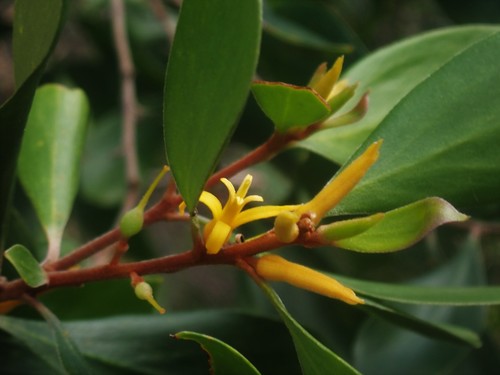
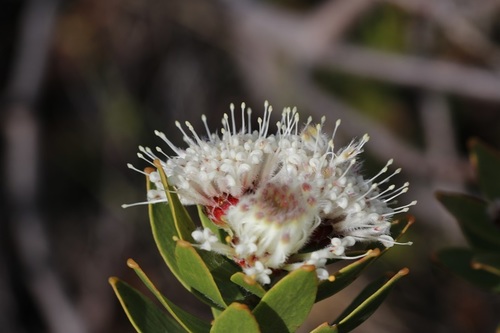
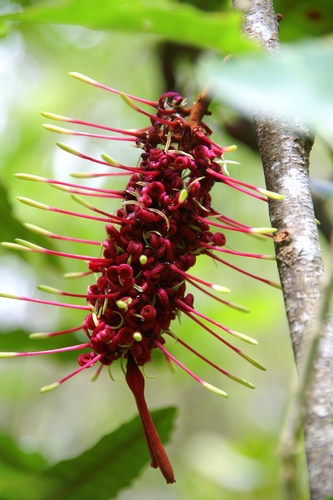
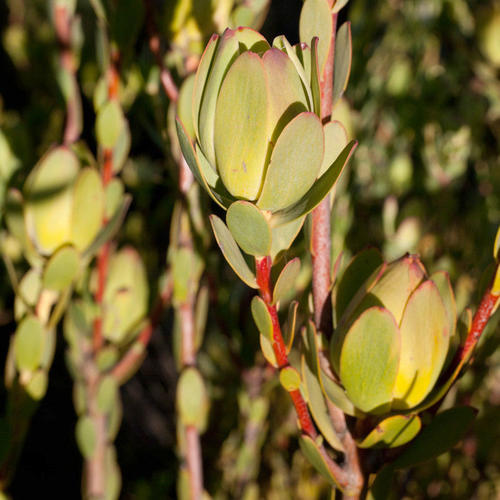
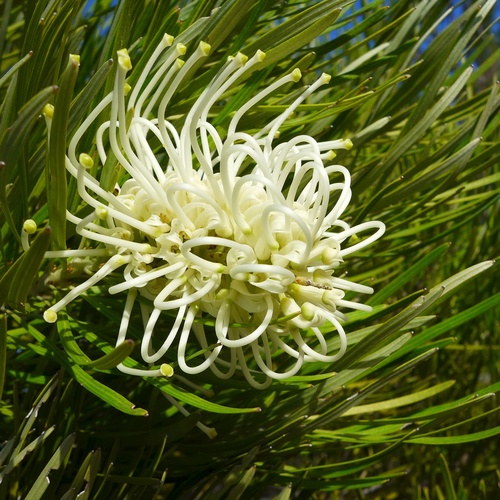
Grevillea exul Lindl. is a species of shrub or small tree. In sheltered areas, it grows as an open tree reaching up to 10 m (33 ft) tall, while in open areas it forms a spreading shrub up to 4 m (13.1 ft) tall. Its leaves are 4.5–13.5 cm (1.8–5.3 in) long and 0.5–5.7 cm (0.20–2.24 in) wide, shaped lanceolate to elliptic, with prominent veins and a blunt apex. The flowers are white with a greenish style end, arranged at the end of branches in an inflorescence 5–20 cm (2.0–7.9 in) long. The perianth measures 10–15 mm long and 2–3 mm wide, and is slightly widened at its base; before anthesis, anthers enclose the style end, and separate after flowering. The pistil is 26.5–42.5 mm (1.04–1.67 in) long, with a slightly oblique, elliptical conical pollen presenter. Flowering occurs from May to January, with later flowering at higher altitudes. The fruit is a follicle 12–20 mm (0.47–0.79 in) long and 9–15 mm (0.35–0.59 in) wide. This species is widely distributed across New Caledonia, where it grows on valleys, ridges and slopes from 6 to 1,250 metres (20–4,101 ft) above sea level. It grows in a range of soil types, including serpentine schist, skeletal soil, and alluvial sand, in open forest or scrub habitats. Grevillea exul was cultivated at the Royal Botanic Gardens in Sydney from 1850 until at least 1903, and fell out of cultivation early in the 20th century. In 1988, garden staff recollected the species to re-establish it in cultivation, and shared plant material with the Grevillea Study Group of the Australian Native Plants Society. Today, it is grown in multiple botanical gardens across Australia, including Brisbane Botanic Gardens and the Southwest Pacific Island collection at Royal Botanic Gardens Victoria. It is a hardy, adaptable species that can grow in a wide range of climatic conditions, from tropical climates to cold, wet winters. It tolerates frosts down to -2 °C (36 °F) and withstands dry periods with little negative effect. Plants grown on their own roots grow just as well as those grafted onto a rootstock, most commonly Grevillea robusta. It is a long-lived plant that flowers vigorously during its flowering season, and may be used as an ornamental shrub.