About Grevillea banksii R.Br.
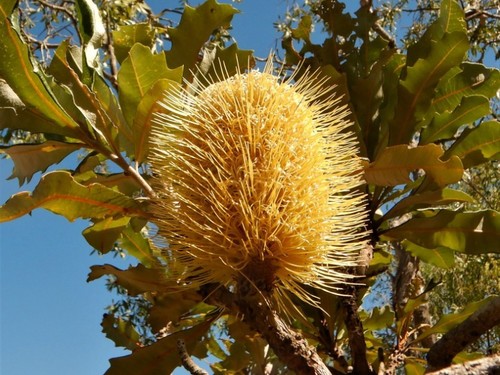
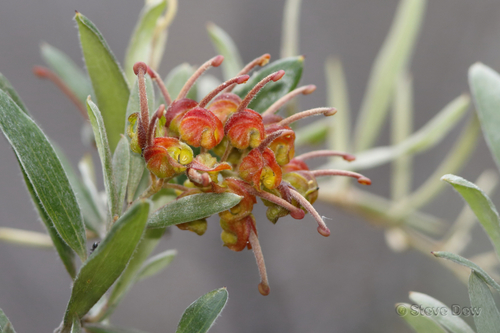
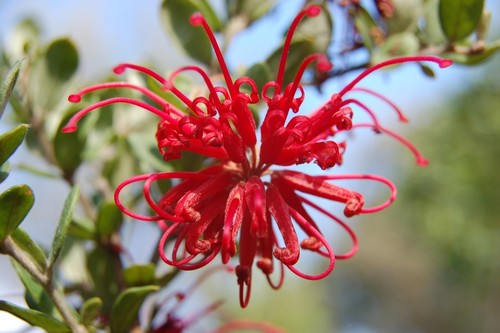
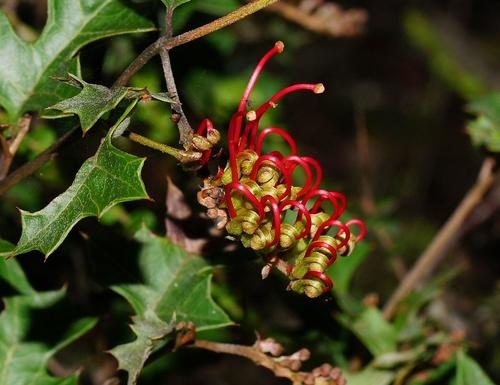
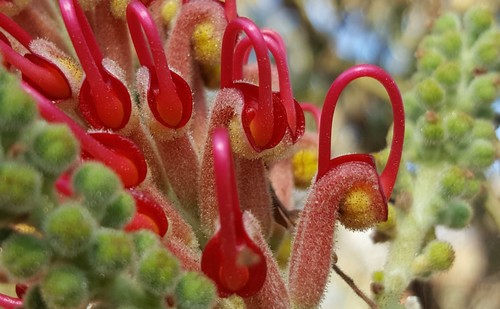
Grevillea banksii R.Br. is an erect plant that grows as a bushy to spindly shrub or a slender tree, typically reaching a height of 2 to 10 metres (6 feet 7 inches to 32 feet 10 inches). Most of its leaves are divided, with four to twelve narrowly elliptic to linear lobes. The lobes are 50 to 180 millimetres (2.0 to 7.1 inches) long and 5 to 15 millimetres (0.20 to 0.59 inches) wide, with edges that are turned down or rolled under. Its flowers are arranged in roughly cylindrical clusters near the ends of branches. Each flower grows on a 3 to 10 millimetre (0.12 to 0.39 inch) long pedicel, arranged along a 50 to 120 millimetre (2.0 to 4.7 inch) long rachis, and flower colour ranges from creamy-white to bright scarlet or crimson. The pistil is 32 to 50 millimetres (1.3 to 2.0 inches) long and usually glabrous. Flowering occurs from August to October, and the fruit is a glabrous follicle 15 to 25 millimetres (0.59 to 0.98 inches) long. Banks' grevillea occurs mostly on the Queensland coast from Ipswich to Yeppoon, and sometimes grows further inland. It grows mainly in woodland and forest, most often on flatter terrain. This species has been introduced to Hawaiʻi, and it is an important woody weed in eastern Madagascar, where it was introduced alongside Acacia dealbata for erosion control. The flowers and seed pods of this species contain toxic hydrogen cyanide. Alkyl resorcinols present in G. banksii and Grevillea 'Robyn Gordon' cause contact dermatitis. Grevillea banksii is one of the most widely cultivated grevilleas, and it is a parent of cultivated hybrids including G. 'Robyn Gordon', G. 'Superb', G. 'Misty Pink', G. 'Pink Surprise', and G. 'Ned Kelly'.