About Grayia spinosa (Hook.) Moq.
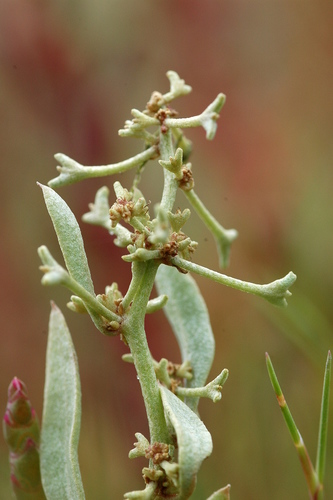
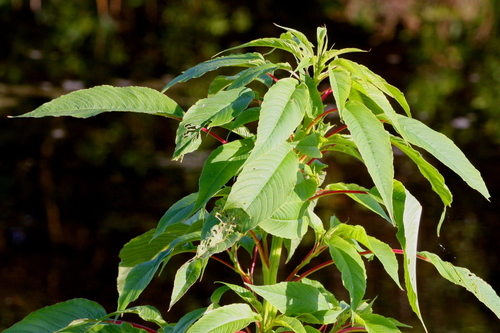
Grayia spinosa is a small, multibranched, brambly shrub that reaches 30 to 100 cm tall, and may grow as tall as 150 cm. Its stems are reddish brown with whitish ribs, and older bark on this species is dark gray. Lateral branches are stiff, ending in spiny, pointed tips. During the growing season, the branches hold small alternate leaves that are flat to scoop-shaped, ranging from 1 to 2.5 cm long (and up to 4.2 cm) and 1.5 to 6 mm wide (and up to 10 mm). The leaf blades are green and oval-shaped, and they often end in a whitish tip.
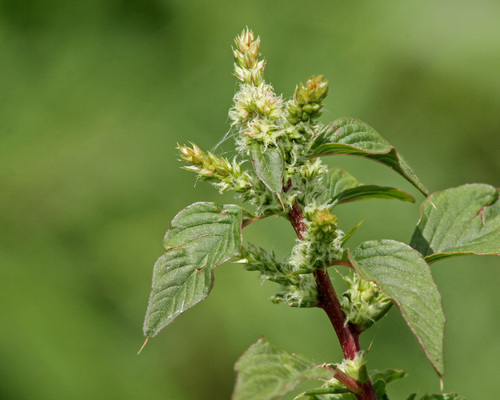
This species is typically dioecious, rarely monoecious. Male plants produce small flower clusters that grow in the axils of leaf-like bracts. Each male flower has 4, occasionally 5, perianth lobes 1.5 to 2 mm long. These lobes are equal to or slightly longer than the 4 to 5 stamens, and the stamen filaments are shorter than the anthers. Female inflorescences hold one or a small number of pistillate flowers in a glomerule. The flowers are enclosed by two completely united bracteoles, have no perianth, and consist of an ovary with two stigmas that protrude through the opening in the surrounding bracteoles.
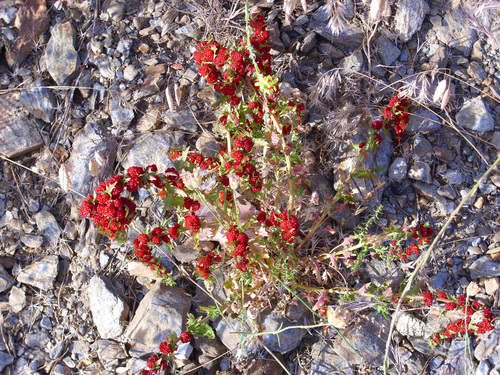
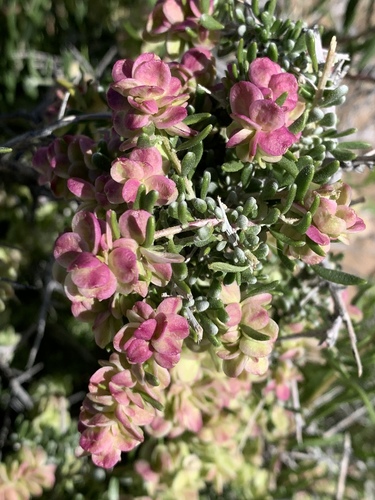
When the plant fruits, the orbicular to broadly elliptic bracteoles enlarge to 7.5-14 mm long by 6–12 mm wide, forming a flattened wing-like structure. These enlarged bracteoles turn bright pink, red-tinged, yellowish green, or whitish, making this one of the more colorful shrubs in its springtime habitat. The enclosed fruit, called a utricle, is brown, measures 1.5–2 mm, and has a free pericarp. The vertically oriented seed is compressed-lenticular with a brown, tuberculate seed coat. An annular embryo surrounds a large amount of perisperm. The chromosome number for this species is 2n = 36. In hot or dry areas, this shrub loses its leaves and flowers by summer, growing into a woody gray thicket; it is evergreen in some regions.
Grayia spinosa is native and widely distributed across the Western United States, specifically found in Colorado, Idaho, Montana, Oregon, Washington, Wyoming, Arizona, California, Nevada and Utah. It grows in valleys and at foothills between 500 and 2400 m in elevation, occurring on dry, alkaline or slightly alkaline soils, within sagebrush, shadscale, or creosote bush communities.