About Grammostola pulchripes (Simon, 1891)
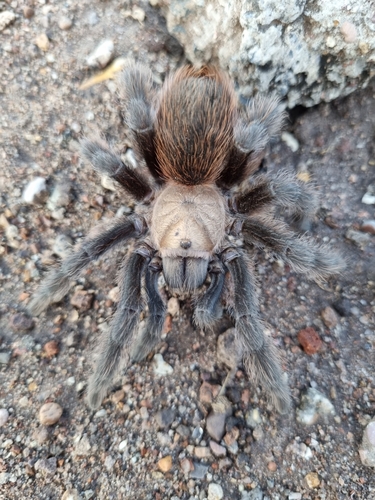
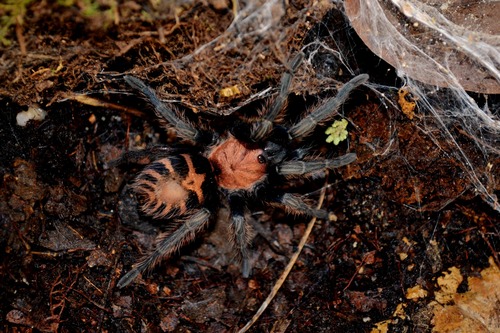
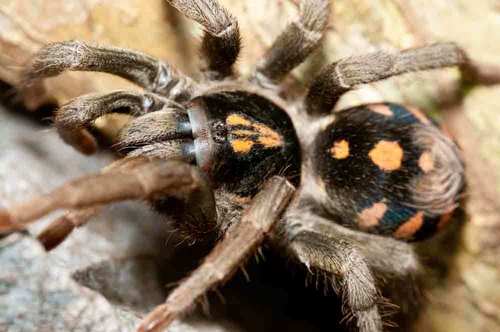
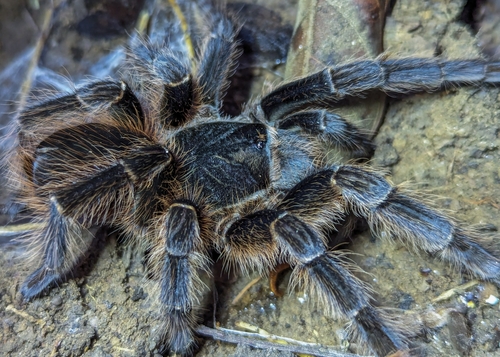
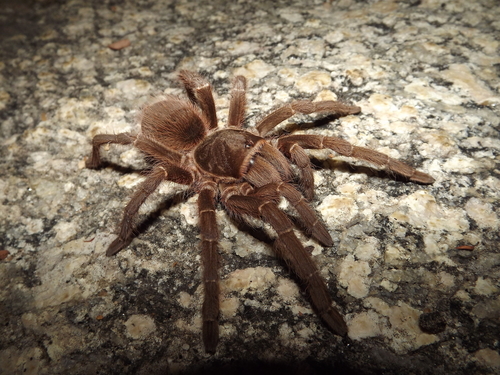
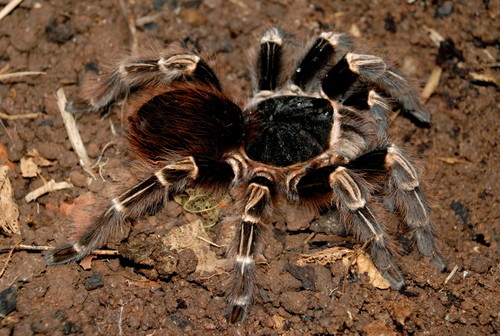
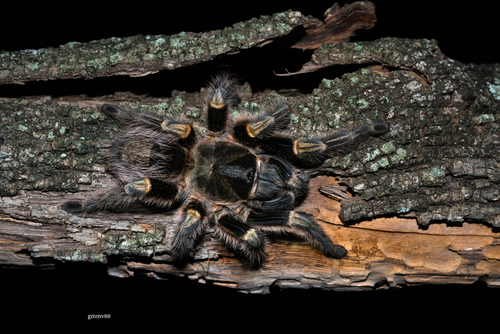
Description and behavior: The Chaco golden knee, known scientifically as Grammostola pulchripes, is a large terrestrial tarantula with a heavy body. Its legspan reaches 7 to 8 inches (17.8 to 20.3 cm). Mature males have longer legs and smaller bodies than females; they have tibial hooks (also called apophyses) that hold a female’s fangs back during mating, plus modified pedipalps to insert sperm into the female’s genital operculum. This tarantula displays multiple distinct colors: bright yellowish stripes on its legs, dark black "femurs," and pink hairs covering its entire body. Like all species in the genus Grammostola, the Chaco golden knee has very large fangs, and its carapace (the top of the prosoma) is raised to accommodate its large chelicerae. It has only rudimentary eyesight, and instead senses its environment using setae covering its body. These setae detect vibrations traveling through the ground and air, and collect chemical signatures that function similarly to a sense of smell. Natural habitat: Chaco golden knee tarantulas live in the grasslands of Argentina and Paraguay. They are adapted to a generally warm climate that has alternating dry and rainy seasons.