About Grammia parthenice W.Kirby, 1837
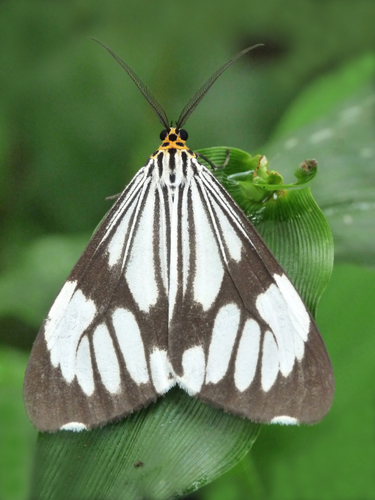
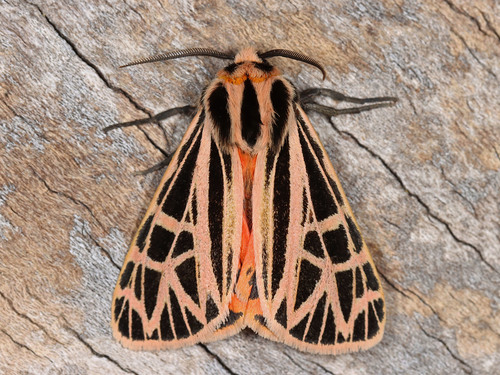
The parthenice tiger moth, currently scientifically named Apantesis parthenice (originally published as Grammia parthenice W. Kirby, 1837), is a moth species in the family Erebidae. It is distributed in southeastern Canada and the eastern United States, and is commonly found in fields and woodland edges between June and late September. Adults are nocturnal and are attracted to light sources. This moth has a wingspan of approximately 7.5 cm (3 inches). Its forewings and thorax are black, marked by a complex network of prominent white veins and white margins. The hindwings and abdomen are orange-pink with black patches. Its bold bright wing striping gives the group the common name "tiger moth", and this species has a stout, furry body. The caterpillars of this species are dark with contrasting bright markings, and are covered in stiff hairs. Both adults and caterpillars are toxic, like other tiger moth species that contain toxic compounds. The bright patterns of both adult and larval parthenice tiger moths act as a warning to predators. Contact with the hairy bodies of these caterpillars may cause skin irritation. Like other tiger moths, this species has a well-developed hearing organ, called a tympanum, on each side of its thorax. The larvae feed on a variety of low-growing plants, including dandelion, Vernonia, and thistles. This species was previously classified in the genus Grammia, but was moved to the genus Apantesis alongside all other species from the genera Grammia, Holarctia, and Notarctia.