About Gossypium sturtianum (R.Br.) J.H.Willis
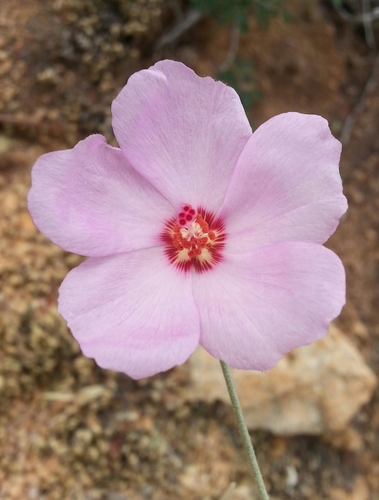
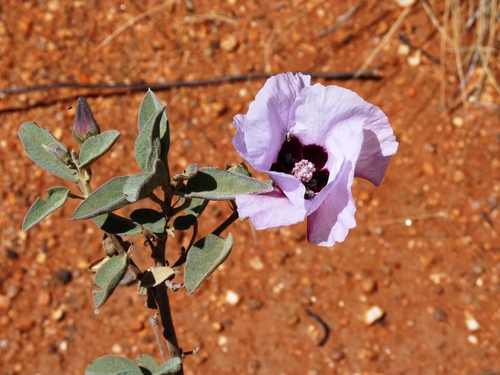
Gossypium sturtianum, commonly called Sturt's desert rose, is a woody shrub that is closely related to cultivated cotton. It is distributed across most mainland Australian states and the Northern Territory. This species also has other common names: Darling River rose, cotton rosebush, and Australian cotton. This plant has an approximate lifespan of 10 years, and reaches 1–2 m in both height and width. Its flowers can grow up to 12 cm in diameter, and are visible through most of the year, with a flowering peak in late winter. Petal colour ranges from pale pink to dark purple to maroon. Five petals are arranged in a whorl, and all have a dark red centre. Its leaves vary in shade of green, are round in shape, and release a strong scent when crushed. It is the floral emblem of the Northern Territory, and is featured on the Flag of the Northern Territory. Sturt's desert rose grows in sandy and gravelly soils, along dry creek beds, watercourses, gorges, and on rocky slopes. It has several key adaptations to its habitat: it has fewer stomata (the pores that enable gas exchange in leaves), or its stomata are protected. All stomata are located on the underside of the leaf, which reduces the plant's water loss. It also has internal water storage tissue, and a deep root system that can access water deep underground. This species contains gossypol, a chemical that is toxic to non-ruminant animals. The first European to record this flower was Charles Sturt, who encountered it between 1844 and 1845, and the species is named after him. In 1947, James Hamlyn Willis assigned the shrub its current accepted scientific name. It is not classified as being at risk of extinction in the wild. A stylized version of Sturt's desert rose, which has seven petals instead of the natural five, appears on the Northern Territory's official flag.