About Gorteria diffusa Thunb.
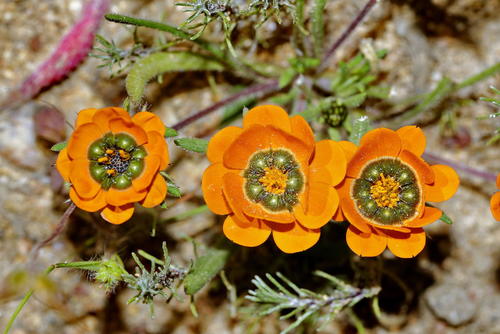
Gorteria diffusa Thunb. starts out as an erect plant, but quickly grows into a creeping annual that is 2–20 cm (0.79–7.87 in) tall. Occasionally, it can survive beyond one growing season and develop into a small shrub. This species is highly variable in the number, shape, color, and spotting of its ray florets, and fourteen distinct forms have been identified. Its stems branch from the base, and often branch again closer to their tips. Stems are either reddish or green, and covered in long, stiff hairs. Basal leaves are 2.5–9 cm (1–3.5 in) long and 2–10 mm (0.079–0.394 in) wide. Stem leaves become gradually smaller toward the tip of the stem, measuring 0.5–5 cm (0.2–2 in) long and 1–10 mm (0.04–0.4 in) wide. All leaves are widest below their midpoint, are mostly smooth-edged (entire), but sometimes have pinnate incisions. They have many stiff hairs on their upper surface, and their margins curl downward. Flower heads are at least 2 cm (0.8 in) across, but most measure 3–5.5 cm (1.2–2.2 in) across. The involucre (a pitcher-shaped structure formed by 18 to 32 green or reddish bracts with red or blackish tips) becomes more inflated and woody as it matures. The free tips of the involucral bracts cover at least the upper two-thirds of the involucre; they are more or less upright when young, and bend outward as the flower head matures. The involucre encloses one full, and sometimes a second incomplete, whorl of slightly overlapping infertile ray florets, numbering 7 to 9 in some forms and 12 to 14 in others. Ray floret base color can range from near-white, through yellow, to orange, while the underside ranges from grayish to dark orange-brown. Many ray florets have a darker zone at their base, which can be clear yellow or orange-brown. All ray florets may have yellow markings, or some or all may have dark blotches. Blotched ray florets may be smaller and brighter in color than unblotched ones, or share the same size and color. Ray florets are egg-shaped, oval, or narrowly oval, extending at least as far out as the involucral bracts (and often much further). They are 10–23 mm (0.39–0.91 in) long and 2–6 mm (0.079–0.236 in) wide, with a pointed or blunt tip that usually has four teeth. Dark blotches can be raised or flat, and are dark green, brown, or purple with black tones, with 1 to 4 small white spots. Blotches have stripes and sometimes hair away from their base. Within the ray floret whorls are 30 to 40 yellow or orange disc florets. Each disc floret is star-shaped with five lobes; the outer ring of disc florets are bisexual, while the central disc florets are functionally male. Disc florets have hairs on their outer surface, often more concentrated near the top, plus few to many very short glandular hairs. The style has two branches, which are less developed in the male central disc florets. The one-seeded, indehiscent fruits (called cypselas) are about 4 mm (0.16 in) long, with an asymmetrical pear shape that is flatter on the side facing the flower head center. The fruit surface is hairless near its base, and felty hairy near its tip, with no ribs. It sometimes has globe-shaped glands and twisted twin hairs. A pappus is either absent, or present as a very small fringe. This species is endemic to a region stretching from the Orange River (on the border with Namibia) in the north, to Clanwilliam, Western Cape in the south. This region has cool rainy winters and dry hot summers. The flower heads of Gorteria diffusa are visited by generalist insect species such as honey bees and monkey beetles, as well as by the specialist bee fly Megapalpus capensis (synonym M. nitidus). The raised spots that often occur on some or all ray florets strongly resemble the body of this bee fly. When spots are absent, male Megapalpus capensis make fewer visits to flower heads, but this has no impact on seed set. The flies are not attracted to simple solid black spots. Researchers conclude these spots are an example of pollinator mimicry: male pollinators are deceived into believing the spots are female flies, leading to more visits to the flower head. While this mimicry strategy is not unique to G. diffusa, it is largely restricted to orchids. Like other Gorteria species, G. diffusa cypselas do not detach from the flower head when ripe. Initially, mostly only one cypsela germinates while still inside the flower head. In G. diffusa, remaining cypselas have been observed to germinate in later years, allowing the species to survive drought periods when successful seed set does not occur.