About Goodyera repens (L.) R.Br.
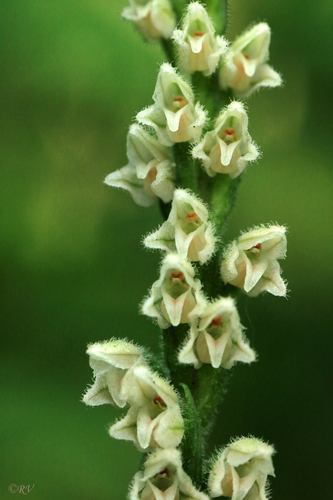
Goodyera repens (L.) R.Br. is a small perennial orchid that grows from short, shallow-rooted rhizomes. It produces evergreen basal leaves, which are either broadly or narrowly ovate, with either a narrow or blunt tip. These leaves measure 1.1 to 3.2 cm (0.4–1.3 in) long and 0.5 to 1.8 cm (0.2–0.7 in) wide. Each plant has between two and six leaves. Many North American plants have silvery white or greenish white tissue along their lateral veins, but these markings are faint or absent in some populations, especially those in Europe and Asia. The pubescent stem bears alternate, scale-like leaves. The inflorescence is a 10–20 cm tall spike that holds 7 to 36 small white or pale-green flowers, arranged closely along one side of the raceme. Individual flowers have a concave, pouch-shaped labellum, and a curved hood-like structure formed by the dorsal sepal and petals that covers the column. Like all species in the genus Goodyera, the stem and sepals are covered in fine thin hairs. Flowers mature sequentially, starting with the lowest flowers on the spike first. The fruit is a capsule around 1 cm long, which holds numerous tiny wind-dispersed seeds that each weigh 0.003 milligrams. Each seed is made up of an undifferentiated embryo surrounded by a transparent seed coat. The flowering period runs from early July to mid-September, varying with latitude. This species has a wide native distribution across northern latitudes, with native populations in Europe, Asia, and North America. It grows in undisturbed, old-growth conifer and mixed forests. In North America, it has a transcontinental range across Canada, with several discontinuous populations in the United States. The northern edge of its range reaches Alaska, Yukon, and Newfoundland. In the eastern United States, it extends south along the Appalachian Mountains to North Carolina and Tennessee. Disjunct populations also exist in Arizona, New Mexico, and Colorado. Historically, native populations in Europe were restricted to Eastern, Northern, and Central regions, with Western European populations limited only to high elevation areas. Over the last century, however, its range has expanded, and new secondary populations have become established in Denmark, the Netherlands, northern France, northern Germany, and eastern England. Goodyera repens is a protected species across most of its range. It cannot survive fire, and does not quickly recolonize areas after fire or logging; it is generally only found in forests that are at least 95 years old. Like other orchids, Goodyera repens lives in symbiosis with mycorrhizal fungi that grow on its rhizomes, specifically Ceratobasidium cornigerum or Rhizoctonia goodyearae-repentis. These mycorrhizae help the orchid absorb and assimilate nutrients. During the plant's first subterranean heterotrophic life stage, it is completely dependent on these fungi, because the tiny seeds contain only very small energy reserves stored as lipids. Bumblebees are important pollinators for this species. Mature flowers produce nectar and have exposed stigmas that support pollen transfer. Hoverflies and halictid bees are also common pollinators. In North America, Goodyera repens was used medicinally by multiple Indigenous peoples. The Mohegan people of Connecticut used this orchid to prevent thrush in infants. The Potawatami used the plant to treat conditions of the female reproductive system, stomach, and bladder, and also as a treatment for snake bites. Some early European settlers in North America used Goodyera repens to treat scrofula and eye infections, and used it as a demulcent.