About Goodyera pubescens (Willd.) R.Br.
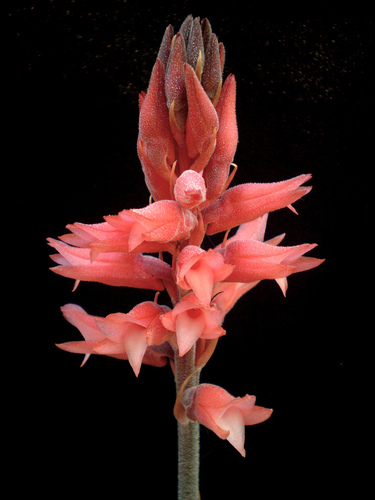
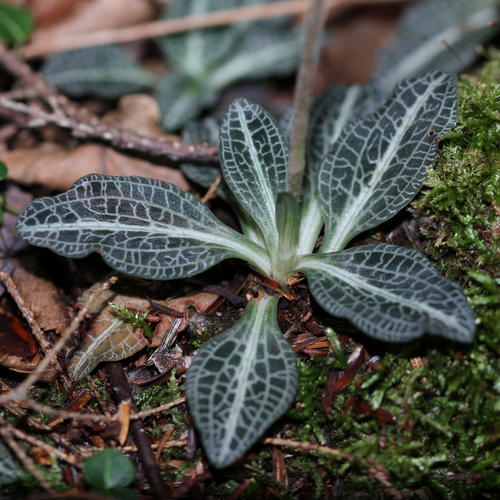
Goodyera pubescens (Willd.) R.Br. is a species of orchid in the Orchidaceae family native to North America. All members of the Goodyera genus, commonly called rattlesnake plantains, are terrestrial plants with fleshy rhizomes and basal evergreen leaves arranged in a rosette. Their leaves frequently have white or pale green markings, and their venation pattern resembles snakeskin, giving the genus its common name. Goodyera plants produce spiked inflorescences of small flowers, which are typically white with green or brown markings and have a fragrant scent. Most parts of the plant, except the petals, are covered in fine small hairs. The main distinguishing feature between Goodyera and the related orchid genus Spiranthes is that Goodyera has elliptic leaves with white or pale green markings. Goodyera pubescens flowers from mid-July to early September, producing a small spike inflorescence holding between 10 and 57 cylindric flowers. Its leaves have white-green marbling along their veins, are broadly elliptic to broadly ovate, measuring 2.1–6.2 cm long by 1.3–3 cm wide, and have either an acute or obtuse apex. The peduncle, the stem that connects each floret to the main stalk, is 11–35 cm long. For its flowers, the lateral sepals are 3.1–5.3 mm long, and the distinct petals are 3.6–5.7 mm long. The petal lip is pouch-shaped (scrotiform), measuring 2.5–4.2 mm long by 2.2–3.5 mm wide, with a reflexed (outward bent) apex and a slightly tuberculate (bumpy, rough) outer surface. The inner surface of the lip is smoother, but has thicker veins running through it. The anthers are inflexed (bent inward) within a cup-shaped clinandrium, a specialized orchid structure that sits beneath the anther. Its white flowers are typically borne atop a leafless stalk. Goodyera pubescens can be confused with other similar species in the Goodyera genus. Dwarf Rattlesnake plantain, G. repens, has smaller flowers and its inflorescence is only arranged on one side of the stalk. Both G. tesselata and G. oblongifolia are found only in Canada. G. tesselata can be told apart by its dull green leaves with much paler veins, while G. oblongifolia has only one primary vein on its leaves, unlike the dense network of veins found in G. pubescens. Goodyera pubescens is distributed across most of eastern North America, ranging from Florida north to Ontario, and west as far as Oklahoma. It occurs in the following US states: Alabama, Arkansas, Connecticut, District of Columbia, Delaware, Florida, Georgia, Iowa, Illinois, Indiana, Kentucky, Massachusetts, Maryland, Maine, Michigan, Minnesota, Missouri, Mississippi, North Carolina, New Hampshire, New Jersey, New York, Ohio, Oklahoma, Pennsylvania, Rhode Island, South Carolina, Tennessee, Virginia, Vermont, Wisconsin, West Virginia. In Canada, it occurs in New Brunswick, Nova Scotia, Ontario, and Quebec. This species grows best in mesic to dry forests. It prefers well-drained, slightly acidic soil with a relatively high sand content, and requires heavy shade from a closed tree canopy or shrubs, though it can easily be outcompeted by smaller shrubs. Good drainage is essential, because oversaturated soil often causes death in this orchid species. It can grow in both dry and moist conditions, in soil types ranging from sandy loam to loam with a high clay content. It can also be found in both deciduous and coniferous forests, as both provide the partial shade it requires. Goodyera pubescens is classified as a National Wetland Indicator Species. Compared to other orchid genera, Goodyera is fairly hardy. It survives cold conditions more readily, can use a wider range of nutrients, and thrives in more soil types under broader lighting conditions. Goodyera pubescens has a germination rate of over 90% even in very cold climates, which allows it to grow in cold regions such as the northern United States and Canada. It prefers loamy soils or humus, but it will also grow into decaying wood of Liriodendron tulipifera (tulip-poplar) or Quercus alba (white oak), and prefers woody substrates with a high amount of fungal activity. However, the rhizomes of G. pubescens cannot survive particularly harsh winters at the northern edge of its distribution. Goodyera pubescens spreads via rhizome to form clonal colonies, and only flowers once per year once it reaches maturity, at 4–8 years of age. After flowering, the parent root produces one to three offshoots that grow into new rosettes; these become new independent plants after the parent plant dies. Most individual G. pubescens do not survive long enough to reach maturity. Mature rosettes will only flower after being triggered by a spring dry period (usually in May) paired with higher than average temperatures. These specific conditions do not occur every growing season, and can take several years to appear, which explains the species' long time to maturity. White-tailed deer (Odocoileus virginianus) preferentially eat the leaves, rosettes, and inflorescences of G. pubescens. As deer populations have increased over the last several decades, the number of rosettes per G. pubescens plant has increased to offset the portion consumed by deer. Goodyera pubescens is mostly used as an ornamental plant for wildflower plantings, valued for its interesting leaf structure and hardiness. Historically, Native Americans used it as a medicinal plant to treat a wide range of ailments. Roots were made into a tea to treat lung inflammation, breathing pain, and snakebites. Leaves were used to improve appetite, treat colds, address kidney problems, reduce joint pain, and treat toothaches. Wilted leaves were used to cool burns, treat skin ulcers, and relieve pain. These are historical and cultural uses, and are not currently recommended. While this orchid is aesthetically desirable to many gardeners, keeping it alive in a non-wild setting is challenging. Its requirements for infrequent sunlight, acidic soil, high fungal activity, and excellent drainage make it difficult to cultivate in home gardens. It is only available from specialty nurseries, because collecting specimens from the wild is not endorsed and usually results in the death of the plant.