About Goodenia paradoxa (R.Br.) K.A.Sheph.
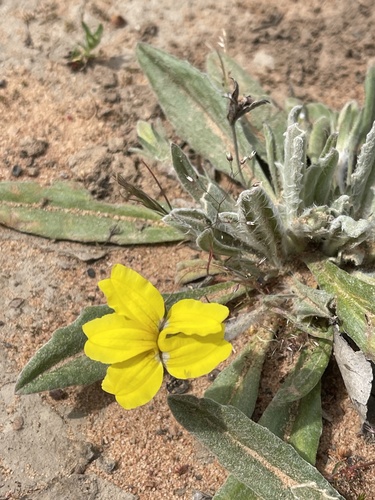
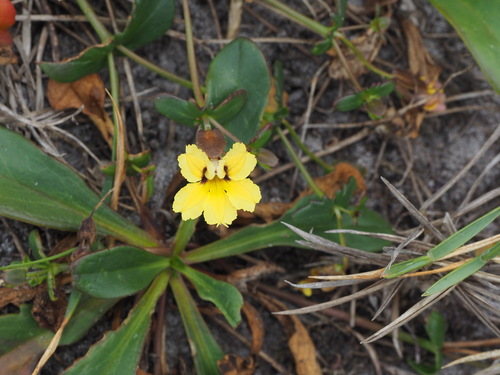
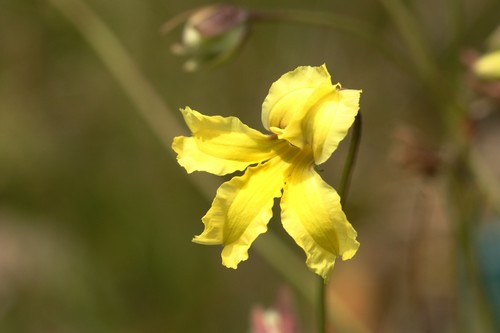
Goodenia paradoxa (R.Br.) K.A.Sheph. is a perennial herb covered in soft hairs, with ascending to prostrate flowering stems that reach up to 60 cm (24 inches) long. Its leaves are egg-shaped with the narrower end toward the base, or elliptic. They measure 70–250 mm (2.8–9.8 in) long and 15–35 mm (0.59–1.38 in) wide, have toothed edges, and grow in a rosette at the base of the plant. At the base of each flower, there are oblong to egg-shaped bracteoles up to 40 mm (1.6 in) long. The sepals are oblong to egg-shaped, 4–9 mm (0.16–0.35 in) long. The petals are yellow, 10–20 mm (0.39–0.79 in) long, with wings up to 3 mm (0.12 in) long extending to the base of the lower sepal. Flowering occurs mostly between August and February. The fruit is a compressed oval capsule 7–9 mm (0.28–0.35 in) long, containing smooth, round seeds 3–5 mm (0.12–0.20 in) in diameter.
This species is widespread across Victoria, New South Wales, south-eastern South Australia, and southern Queensland, where it grows in sclerophyll forest and grassland. There are also recorded occurrences at a small number of sites in Tasmania, including Hobart, Launceston, the Northern Midlands, Southern Midlands, and the Derwent Valley. In Tasmania, Goodenia paradoxa is listed as vulnerable under the Tasmanian Government Threatened Species Protection Act 1995.