About Goodenia paniculata Sm.
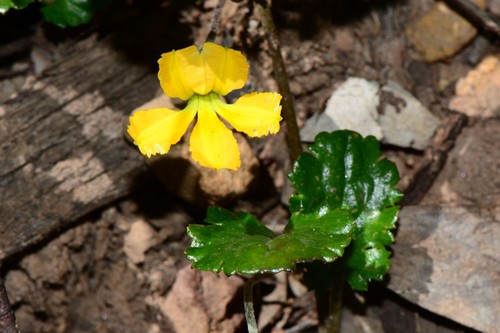
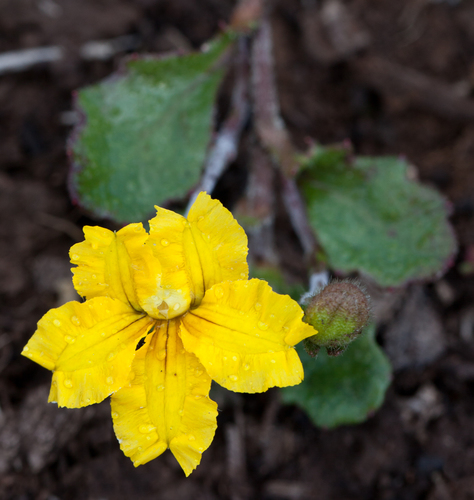
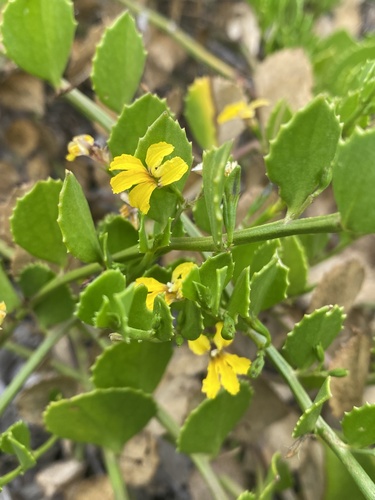
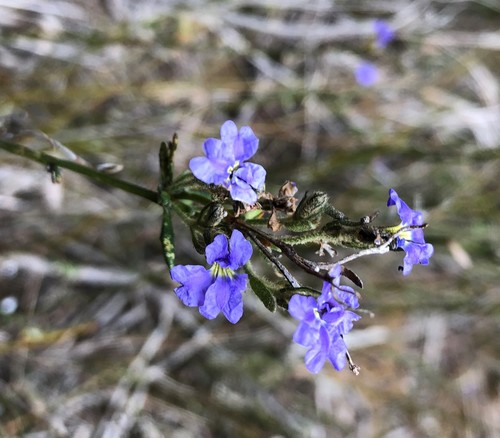
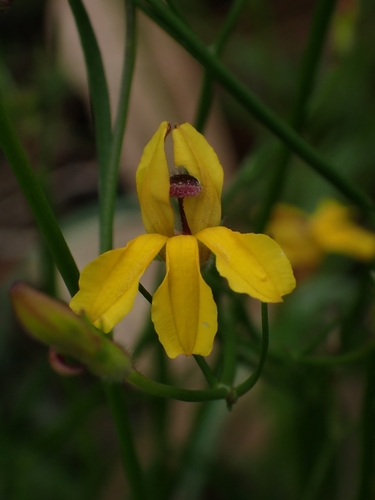
Goodenia paniculata, commonly called branched goodenia, is a short-lived herb that typically grows to a height of 50 cm (20 in) and produces many adventitious roots. Most of its leaves are located at the base of the plant; they are egg-shaped to lance-shaped with the narrower end pointing toward the base, measure 14–100 mm (0.55–3.94 in) long and 6–10 mm (0.24–0.39 in) wide, and have toothed edges. Flowers are arranged in racemes or thyrses up to 250 mm (9.8 in) long, borne on a 7–80 mm (0.28–3.15 in) long peduncle. The inflorescence has linear to narrow elliptic bracts 4–40 mm (0.16–1.57 in) long, and bracteoles 1.5–2 mm (0.059–0.079 in) long. Each individual flower sits on a 6–16 mm (0.24–0.63 in) long pedicel, with triangular to lance-shaped sepals 1–2 mm (0.039–0.079 in) long. The corolla is 10–14 mm (0.39–0.55 in) long, with lower lobes 5–6 mm (0.20–0.24 in) long and wings roughly 1.5 mm (0.059 in) wide. Flowering occurs mainly from October to April, and the fruit is a spherical to oval capsule 5–6 mm (0.20–0.24 in) long.
Branched goodenia grows in freshwater wetlands or swampy habitats on clay, silty, or sandy soils, most often along the coast. It can tolerate soils with a pH as low as 2.5. Its range extends from Queensland through eastern New South Wales to south-eastern Victoria, reaching as far west as Rosedale. In New South Wales, it occurs mainly in coastal areas, but can also be found as far inland as the Blue Mountains and Nerriga. It grows in heath or woodland plant communities dominated by trees including thin-leaved stringybark (Eucalyptus eugenioides), broad-leaved red ironbark (Eucalyptus fibrosa), forest red gum (Eucalyptus tereticornis), woollybutt (Eucalyptus longifolia) and white feather honeymyrtle (Melaleuca decora), and shrubs including prickly-leaved paperbark (Melaleuca nodosa), Deane's paperbark (Melaleuca deanei), and tantoon (Leptospermum polygalifolium).