About Goodenia heterophylla Sm.
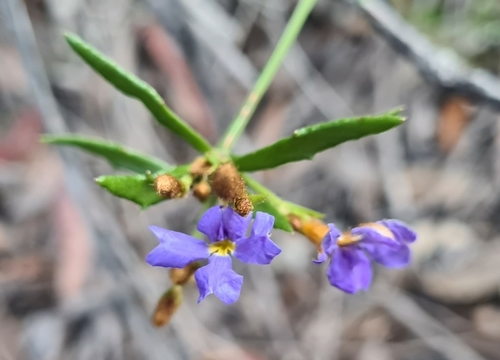
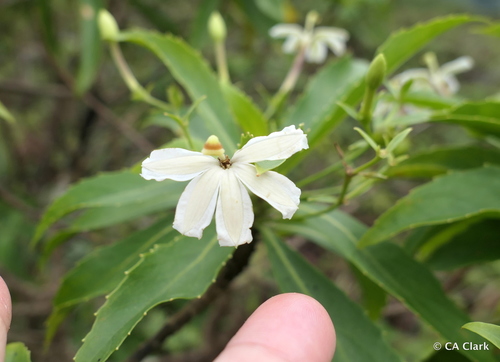
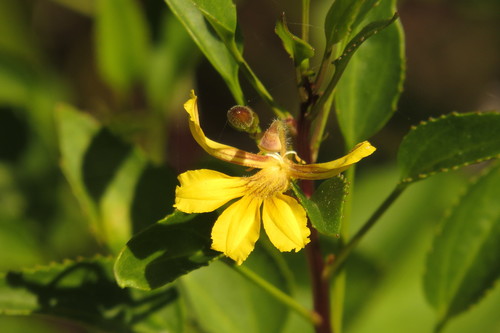
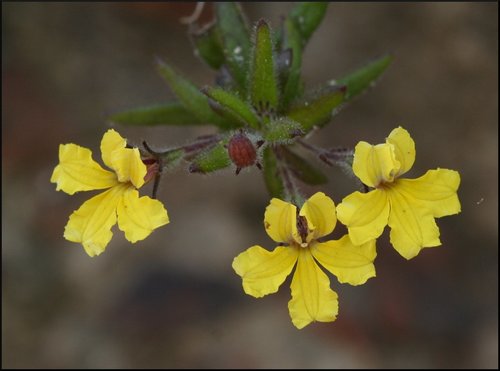
Goodenia heterophylla Sm. is an erect to trailing, more or less woody herb or shrubby plant that reaches a maximum height of 40 cm (16 in). Stem leaves are linear to egg-shaped, 10–40 mm (0.39–1.57 in) long and 2–10 mm (0.079–0.394 in) wide. These leaves are sessile, and sometimes have toothed or lobed edges. Leaves at the base of the plant are ephemeral. Flowers are arranged in leafy racemes or thyrses up to 300 mm (12 in) long, borne on a 6–15 mm (0.24–0.59 in) long peduncle with linear bracteoles 2–4 mm (0.079–0.157 in) long. Each individual flower sits on a 4–7 mm (0.16–0.28 in) long pedicel, with linear to lance-shaped sepals 2–4 mm (0.079–0.157 in) long. The corolla grows up to 12 mm (0.47 in) long, with lower lobes up to 5 mm (0.20 in) long and wings up to 1.5 mm (0.059 in) wide. Flowering occurs mainly from August to May, and the fruit is a broadly oval capsule up to 3 mm (0.12 in) long. This goodenia grows in forest and woodland, most often on sandstone. Subspecies eglandulosa occurs in coastal and tableland areas of New South Wales, ranging from near Wauchope to Jervis Bay. Subspecies heterophylla is mostly found between Gloucester and Lithgow in New South Wales, and sometimes also occurs in north-eastern Victoria. Subspecies montana grows in forest between Lithgow and the Nerriga area, while subsp. teucriifolia is restricted to the Glass House Mountains area in Queensland.