About Goodenia caerulea R.Br.
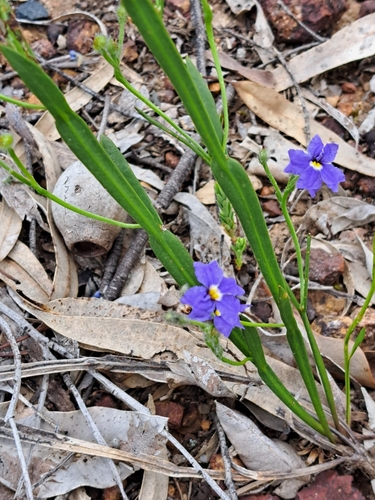
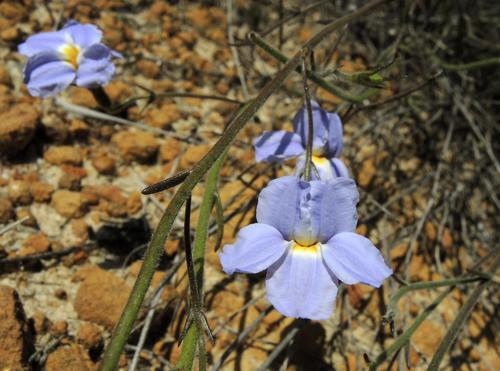
Goodenia caerulea (also spelled Goodenia coerulea), described by Robert Brown, is an erect or ascending shrub or biennial herb. It typically reaches a height of 40 to 50 centimetres (16 to 20 inches), and all its foliage is covered in glandular hairs. Its leaves are linear, sessile, 30 to 70 millimetres (1.2 to 2.8 inches) long, and 1 to 3 millimetres (0.039 to 0.118 inches) wide. Flowers are arranged in racemes that mostly grow up to 300 millimetres (12 inches) long, borne on a 10 to 25 millimetre (0.39 to 0.98 inch) long peduncle. Small, leaf-like bracteoles 2 to 5 millimetres (0.079 to 0.197 inches) long are present at the base of the raceme, and each individual flower sits on a hairy 5 to 20 millimetre (0.20 to 0.79 inch) long pedicel. The sepals are linear to lance-shaped and 3 to 7 millimetres (0.12 to 0.28 inches) long, while the petals are blue and 15 to 25 millimetres (0.59 to 0.98 inches) long. The lower lobes of the corolla are 5 to 10 millimetres (0.20 to 0.39 inches) long, with wings approximately 2 millimetres (0.079 inches) wide. Flowering occurs between September and January, and the fruit produced is an oval capsule 7 to 8 millimetres (0.28 to 0.31 inches) long. This goodenia species is widely distributed across south-western Western Australia, ranging from near Shark Bay to the region's south coast, and it grows in a wide variety of different habitats.